Fishing kills at least 24,000 fishers every year – yet most countries are still refusing to adopt international safety rules
- Written by Dita Liliansa, Ocean Law & Policy Research Associate, National University of Singapore
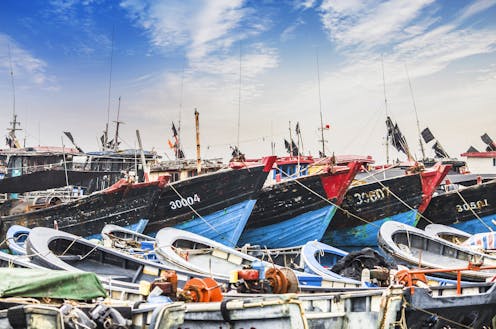
Fishing is one of the most dangerous jobs in the world[1].
The International Labour Organisation has estimated that every year, fishing vessel accidents claim as many as 24,000 fishers’ lives[2]. This figure is more than 10 times more lives claimed than in accidents on merchant ships[3] which transport either cargo or passengers.
Unlike safety of merchant vessels, which is governed by the International Convention for the Safety of Life at Sea (SOLAS[4]), safety of fishing vessels has fallen through the cracks, making it largely unregulated and unmonitored.
Unsafe fishing vessels are also linked to illegal, unreported and unregulated fishing and may contribute to abandoned, lost or otherwise discarded fishing gear[5], which is becoming a global concern as it can be a navigational hazard and major source[6] of ocean plastic pollution.
Yet, there is currently no international treaty governing the safety of fishing vessels that has entered into force.
Fishing vessel safety under international law
167 states and the European Union[7] have ratified the United Nations Convention on the Law of the Sea, which obliges every state to ensure safety at sea for all ships flying its flag.
For decades, the International Maritime Organisation (IMO), the United Nations’ specialised agency for regulating international shipping, hasn’t succeeded in bringing regulatory instruments on fishing vessel safety[8] into force.
The latest treaty on fishing vessel safety is the Cape Town Agreement, which was adopted in 2012 to update, amend, and replace the previous treaty: the 1993 Torremolinos Protocol. However, there are only 17 contracting parties with just over 1,000 eligible fishing vessels to date – far from the minimum requirements for the Agreement to enter into force.
The Cape Town Agreement states[9] the conditions to ensure the seaworthiness of fishing vessels of 24 metres in length and over. It requires the availability of life-saving appliances, communications equipment, and fire protection[10] on fishing vessels.
Read more: The government now has a much-needed regulation on the recruitment of migrant fishers from Indonesia. What next?[11]
In October 2019, during an IMO-led conference on fishing vessel safety and illegal, unreported and unregulated fishing[12], there was a momentum for the Cape Town Agreement to gain wider support.
During and after the conference, a total of 51 states declared their commitment to ratify the Cape Town Agreement[13] by the tenth anniversary of the adoption of the agreement, which was 11 October 2022.
Since the 2019 Conference, however, the Agreement has only gained four additional ratifications, far below expectations. The tenth anniversary of the Agreement has now passed and the Agreement still has not entered into force.
What about Indonesia?
Many Asian states are among the world’s top seafood producers[15]. At least two-thirds of 4.1 million global fishing vessels[16] are flagged to Asian states.
Unfortunately, none of the Asian states are parties to the Cape Town Agreement.
Indonesia, the world’s second largest seafood producer, claims to have more than 600,000 fishing vessels[17] in 2014.
The exact number of Indonesian fishing vessels remains unknown. But the majority of Indonesian fishing vessels are small-scale fleets, which are likely beyond the scope of the Cape Town Agreement.
Read more: Indonesia's patron-client system: both a bane and hope for sustainable fisheries[18]
Many Indonesian fishers also work for foreign fishing vessels. The latest data[19] shows 186,430 Indonesian nationals working on board Malaysian fishing vessels; 12,278 on Taiwanese fishing vessels; and 4,885 people on South Korean fishing vessels in 2018.
Sadly, none of these countries are parties to the Cape Town Agreement. Thus, it is very likely that their domestic regulations on fishing vessel safety vary. Leaving it to each country to regulate fishing vessel safety is problematic, as some countries can be more lenient than others.
An international regulation like the Cape Town Agreement would resolve this problem, by ensuring uniform minimum standards that are applicable to all states.
How to protect more lives at sea
Governance of fishing vessel safety is more than a century behind that of commercial shipping, even though fishers’ lives are just as priceless as seafarers.
As both workers have the same right to work in a safe environment at sea, fishing vessels shall receive equal attention as commercial shipping. Thus, wider ratification to the Cape Town Agreement is necessary.
Countries with large numbers of migrant fishers, like Indonesia, should have the highest interest to ensure that the Cape Town Agreement enters into force as soon as possible. This is critical to ensure that their nationals are not working on substandard fishing vessels that could put their lives in danger.
We must hope that more nations will finally act and ratify the Cape Town Agreement, so that we’re no longer losing tens of thousands of fishers’ lives at sea every year.
References
- ^ one of the most dangerous jobs in the world (www.arinite.co.uk)
- ^ 24,000 fishers’ lives (www.ilo.org)
- ^ 10 times more lives claimed than in accidents on merchant ships (www.pewtrusts.org)
- ^ SOLAS (www.imo.org)
- ^ abandoned, lost or otherwise discarded fishing gear (www.fao.org)
- ^ major source (onlinelibrary.wiley.com)
- ^ 167 states and the European Union (www.un.org)
- ^ hasn’t succeeded in bringing regulatory instruments on fishing vessel safety (www.pewtrusts.org)
- ^ states (www.imo.org)
- ^ communications equipment, and fire protection (www.imo.org)
- ^ The government now has a much-needed regulation on the recruitment of migrant fishers from Indonesia. What next? (theconversation.com)
- ^ an IMO-led conference on fishing vessel safety and illegal, unreported and unregulated fishing (www.imo.org)
- ^ declared their commitment to ratify the Cape Town Agreement (cil.nus.edu.sg)
- ^ Adhi Wicaksono/Greenpeace (www.greenpeace.org)
- ^ the world’s top seafood producers (www.fao.org)
- ^ two-thirds of 4.1 million global fishing vessels (www.fao.org)
- ^ more than 600,000 fishing vessels (news.kkp.go.id)
- ^ Indonesia's patron-client system: both a bane and hope for sustainable fisheries (theconversation.com)
- ^ latest data (meetings.wcpfc.int)
Authors: Dita Liliansa, Ocean Law & Policy Research Associate, National University of Singapore