A hawkish Fed signals further rate hikes and sees a slowing economy – but not recession
- Written by Arabinda Basistha, Associate Professor of Economics, West Virginia University
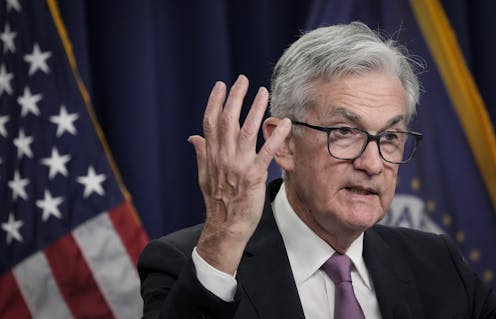
The U.S. Federal Reserve hiked its benchmark interest rate[1] by a further three-quarters of a percentage point on July 27, 2022.
The jump was expected by most economists[2], although some had thought the central bank would go further in its attempts to put the brakes on soaring inflation and impose a full point increase.
The Conversation asked Arabinda Basistha, an economist at West Virginia University[3], to cast an eye over the Fed’s announcement and provide three key takeaways about what it tells us about the economy and future monetary policy.
1. More hawkish on monetary policy
On the surface, the headline decision to raise the interest rate by three-quarters of a percentage point is very much in line with what was expected. But a careful reading of the accompanying statement by the rate-setting Federal Open Market Committee[4] (FOMC) reveals a slightly more hawkish Fed – one that’s more willing to act more aggressively in attempting to calm inflation – than in the last such meeting in June, when it likewise raised rates by three-quarters of a percentage point.
On that occasion, the vote was not unanimous – Kansas City Fed President Esther George opted to go for a half-point raise[5] but was outvoted by colleagues who wanted the more aggressive 0.75% hike in a bid to bring down inflation.
But this time the vote was unanimously[6] in favor of the three-quarter point rise, an indication that the Fed thinks it needs to act more decisively in the face of stubborn cost of living increases.
A notable change in the FOMC statement was the removal of any reference to supply chain disruptions due to COVID-19 in China[7]. That line was in June’s statement, so its absence this time may indicate an easing of the supply chain issues that have contributed to inflation hitting a 40-year high[8].
That aside, Fed Chairman Jerome Powell stuck a downbeat note on inflation in the U.S., acknowledging in a news conference accompanying the announcement that June’s Consumer Price Index hitting 9.1% was “worse than expected.”
2. Expect a further rate hike in September
There is now a clear indication that that the FOMC will impose another rate hike when it meets in September. Powell noted in the news conference[9] that another 0.75 percentage point rise in September “could be appropriate.”
At the same time, he acknowledged that with the latest increase, the Fed’s rate was pretty much in line with what economists call the “neutral” rate of interest[10] – that is, a rate which neither stimulates the economy nor slows it down. The “neutral rate” is assumed to be around 2.5%; the latest FOMC hike puts the Feds’ policy rate up to a range of 2.25% to 2.5%.
So if there were to be another fairly sharp rise in the benchmark interest rate in September, it would push the Fed rate above the neutral rate – a move that would restrict economic growth. Again, this is an indication that the Fed is striking a more hawkish tone on monetary policy.
Powell did mention that a more moderate rate rise in September is possible, but that will likely depend on there being clear data showing price stabilization and an overall softening of the labor market. The job market has been strong for a while, with healthy monthly gains[11]. The Fed will be looking for a decrease in the current high number of job vacancies, along with lower wage inflation, to signal a softening labor market before it can ease back on aggressive rate hikes.
3. Economic output is slowing, but no recession (yet)
In the statement accompanying the FOMC rate decision[12], the Fed noted that recent data showed “spending and production have softened.” Powell expanded on that a little, noting that business fixed investment[13] – that is, how much companies spend on things like machines or factories – had gone down.
This acknowledgment that expenditure is softening wasn’t in June’s statement and is a clear sign that Fed officials believe the economy is slowing down, something Powell acknowledged. Yet at the same time, the Fed chair said the strength of the labor market indicated robust overall demand.
As such, it would seem Powell does not see the U.S. heading into recession, but rather, there will be some slowing down of the economy throughout the second half of this year.
References
- ^ hiked its benchmark interest rate (www.reuters.com)
- ^ expected by most economists (www.reuters.com)
- ^ economist at West Virginia University (business.wvu.edu)
- ^ accompanying statement by the rate-setting Federal Open Market Committee (www.federalreserve.gov)
- ^ opted to go for a half-point raise (www.investopedia.com)
- ^ vote was unanimously (www.federalreserve.gov)
- ^ supply chain disruptions due to COVID-19 in China (www.bloomberg.com)
- ^ inflation hitting a 40-year high (www.politico.com)
- ^ noted in the news conference (www.wsj.com)
- ^ neutral” rate of interest (www.dallasfed.org)
- ^ healthy monthly gains (www.nytimes.com)
- ^ statement accompanying the FOMC rate decision (www.federalreserve.gov)
- ^ business fixed investment (www.chicagofed.org)
Authors: Arabinda Basistha, Associate Professor of Economics, West Virginia University