Symbols of the Confederacy are slowly coming down from US military bases: 3 essential reads
- Written by Howard Manly, Race + Equity Editor, The Conversation US
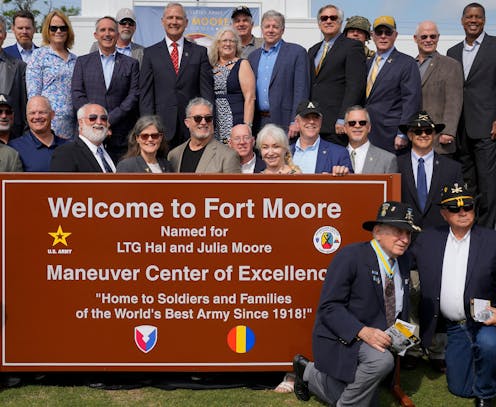
Without much fanfare, a federal panel[1] is removing the names of Confederate generals from U.S. military bases and replacing them with names that exemplify modern-day values and patriotism.
Most recently, on May 11, 2023, the U.S. Army base in Georgia[2] originally named after Confederate Brig. Gen. Henry Benning was renamed Fort Moore after both Lt. Gen. Harold “Hal” Moore[3], who served in Vietnam, and his wife, Julia Moore[4], who had been an advocate for military families and reformed the military’s death notice procedures.
In stark contrast to the Moores, Benning was a leader in the South’s secession movement and strongly defended slavery.
Over the years, The Conversation US has published numerous stories exploring the legacy of Confederate nostalgia, everything from national monuments to U.S. military bases. Here are selections from those articles.
1. Reconsidering Confederate iconography
For decades, nine U.S. Army bases have carried the names of men who fought against the United States and its Union army – in a war waged to defend and perpetuate the slavery of people of African descent.
These military installations, all in Southern states, were named to honor such figures as Gen. Robert E. Lee, who commanded the Confederate Army, and John Bell Hood, an associate of Lee’s known for being both brave and impetuous.
Until recently, the military installations honoring Confederate leaders received little scrutiny from the media. As a newspaper reporter four decades ago, Jeff South[5] gave the names a free pass. In 1981, South wrote[6], he covered the Boy Scouts Jamboree[7] at Fort A.P. Hill in Virginia without mentioning that the base was named for a man who had turned against the United States[8] and fought to defend slavery.
“In recent years, more Americans, including those living in the South, have reconsidered the use of Confederate iconography,” South wrote.
Read more: US moves to rename Army bases honoring Confederate generals who fought to defend slavery[9]
2. Memorializing modern-day values
As a professor of pop culture history[10] who studies Black statues within mainstream society, Frederick Gooding Jr. wrote about America’s reckoning with its oppressive past.
“The nation (faces) the question of not just which statues and other images should be taken down,” Gooding explained[11], “but what else – if anything – should be put up in their place.”
Gooding pointed out that the lack of Black statues, for example, is an overlooked barometer of racial progress and “sends a clear message of exclusion.”
Read more: Old statues of Confederate generals are slowly disappearing – will monuments honoring people of color replace them?[12]
3. Memorials have expiration dates too?
Alan Marcus[13] and Walter Woodward[14] have been studying the role of Confederate monuments and other nostalgia in American memory.
“Historical monuments are intended to be timeless, but almost all have an expiration date,” they wrote[15]. “As society’s values shift, the legitimacy of monuments can and often does erode.”
This is because monuments, including the names of U.S. military bases, reveal the values of the time in which they were created and advance the agendas of their creators[16].
Read more: Monuments 'expire' – but offensive monuments can become powerful history lessons[17]
Editor’s note: This story is a roundup of articles from The Conversation’s archives.
References
- ^ a federal panel (www.defense.gov)
- ^ U.S. Army base in Georgia (www.cnn.com)
- ^ Lt. Gen. Harold “Hal” Moore (www.army.mil)
- ^ Julia Moore (www.fortmoore.com)
- ^ Jeff South (robertson.vcu.edu)
- ^ South wrote (theconversation.com)
- ^ Boy Scouts Jamboree (oa-bsa.org)
- ^ man who had turned against the United States (www.battlefields.org)
- ^ US moves to rename Army bases honoring Confederate generals who fought to defend slavery (theconversation.com)
- ^ professor of pop culture history (honors.tcu.edu)
- ^ explained (theconversation.com)
- ^ Old statues of Confederate generals are slowly disappearing – will monuments honoring people of color replace them? (theconversation.com)
- ^ Alan Marcus (education.uconn.edu)
- ^ Walter Woodward (history.uconn.edu)
- ^ they wrote (theconversation.com)
- ^ advance the agendas of their creators (books.google.com)
- ^ Monuments 'expire' – but offensive monuments can become powerful history lessons (theconversation.com)
Authors: Howard Manly, Race + Equity Editor, The Conversation US