‘Swarm of one’ robot is a single machine made up of independent modules
- Written by Yu Gu, Professor of Mechanical and Aerospace Engineering, West Virginia University
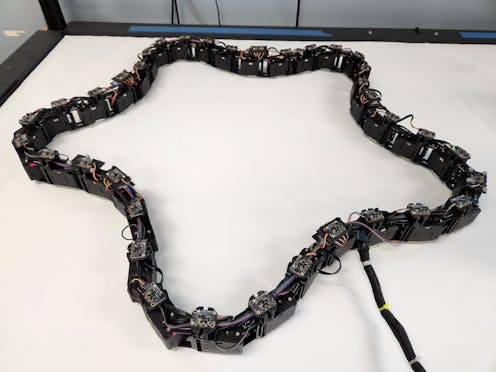
My colleagues and I have built a robot composed of many building blocks like the cells of a multicellular organism. Without a “brain” or a central controller in the system, our robot, dubbed Loopy, relies on the collective behavior of all of its cells to interact with the world.
In this sense, we call Loopy a robotic swarm[1]. But Loopy can also be seen as a single robot since all the cells are connected; therefore, Loopy is also “a swarm of one.” This research could lead to adaptive robots that tailor their shapes and movements to their environments – for example, in environmental cleanup applications.
Loopy is a primitive form of multicellular robot[2] that is made of a ring of 36 cells. Each cell has a rotary servo[3] – an electric motor that rotates a shaft with precise controlled angle of rotation – and sensors. Each cell reacts on its own without input from any of the others except for its two immediate neighbors. As the servos move, the angles between the cells determine Loopy’s overall shape.
Loopy is free to morph into various shapes and exhibit a range of motions. But random shapes and motions are not useful. We were hoping something interesting would emerge from self-organization; that is, the spontaneous creation of order from disorder, without us telling Loopy what to do directly. It turned out that Loopy forms stable shapes that recover after Loopy bumps into obstacles.
Loopy exhibiting spontaneous shapes and motions.Famed mathematician Alan Turing[4] was interested in the idea of self-organization back in 1952. He even envisioned a ring of cells[5]. Turing hypothesized the existence of chemicals that diffuse and react with each other, leading to the creation of patterns in nature[6] like those on bird’s feathers and seashells. This self-organization approach using simulated chemicals enabled Loopy to form and transition between various lobed shapes spontaneously.
Why it matters
Engineered systems, and robots in particular, are predominantly designed with a top-down approach[7], where human designers anticipate the conditions the system may encounter and plan ahead through hardware designs, software programs or both. The problem is, the designers are not likely be there when the robot encounters an unanticipated situation.
This micromanagement approach in robot design is like giving kids a detailed manual when sending them to school the first day. A better way of parenting would be to provide general guidelines and feedback, and expect the kids to solve problems on their own. Similarly, a key motivation of developing Loopy is to unleash the power of bottom-up collective “intelligence[8]” so Loopy can find new solutions on its own when a new situation arises; for example, finding the right shape for self to adapt to the environment.
What other research is being done?
The vision of programmable matter has been around for decades, yet tangible examples have been scarce. While researchers have explored complex shape formation through self-assembly[9] or reconfigurable robotic systems[10], these often depend on predetermined shapes.
Similar to Loopy, researchers have applied Turing’s self-organization concept to swarms of robots[11], such as the small, simple, autonomous Kilobots[12], leading to the emergence of complex shapes. However, unlike Loopy, the physical forces between “cells” are not used to influence the final shape and behavior of the collective.
What’s next?
We would like Loopy to develop more lifelike traits, such as navigating unforeseen situations, seeking out better conditions, acquiring resources and mitigating threats. This vision extends to eventually enabling Loopy to perform tasks assigned by people, thereby bridging the gap between the open-ended creativity of self-organization and human guidance.
The Research Brief[13] is a short take on interesting academic work.
References
- ^ robotic swarm (doi.org)
- ^ primitive form of multicellular robot (doi.org)
- ^ rotary servo (www.youtube.com)
- ^ Alan Turing (www.britannica.com)
- ^ a ring of cells (doi.org)
- ^ patterns in nature (theconversation.com)
- ^ top-down approach (doi.org)
- ^ bottom-up collective “intelligence (link.springer.com)
- ^ self-assembly (doi.org)
- ^ reconfigurable robotic systems (doi.org)
- ^ swarms of robots (doi.org)
- ^ Kilobots (ssr.seas.harvard.edu)
- ^ Research Brief (theconversation.com)
Authors: Yu Gu, Professor of Mechanical and Aerospace Engineering, West Virginia University