Why restaurant self-service kiosks can actually result in customers ordering less food
- Written by Lu Lu, Associate Professor of Sport, Tourism and Hospitality Management, Temple University
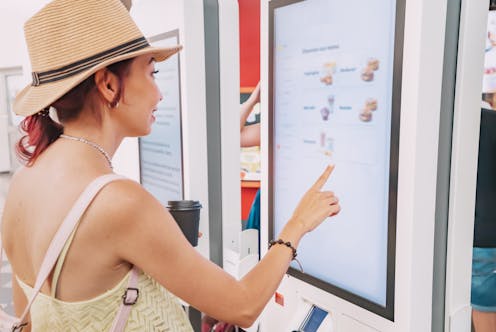
When restaurant customers order from a self-service kiosk while a line forms behind them, they feel rushed, prompting them to buy less and stick to familiar items instead of browsing for something new, according to a recent study we published[1].
We found that businesses can reduce this pressure and increase satisfaction by revamping their system so that a single line of waiting customers leads to multiple kiosks. That way, customers feel less rushed because they aren’t the only ones who may be holding up the line.
We are experts in food and beverage marketing who research self-service technology. In recent years, many restaurants have adopted[2] automated technology to streamline the menu ordering process and address staffing shortages. This ultimately gives customers more control over ordering, but an unintended consequence of this has seemed to be that it also makes them feel more responsibility for keeping the line that forms behind them moving, leading to rushed orders.
To understand what’s going on, we conducted three experiments in which we asked hundreds of participants to imagine waiting in line at a restaurant in a variety of scenarios. We found that most people do in fact feel pressured to order quickly when there’s a queue behind them. This resulted in hasty decisions and lower overall spending.
But we also found that retailers can mitigate this in one of two ways: by creating a single line serving several kiosks or by showing a pop-up message on the kiosk interface stating that the business takes full responsibility for any service delays during menu orders.
Our research reveals the social dynamics at play in do-it-yourself ordering and we believe offers valuable implications for designing a more effective and customer-friendly self-service process. It also alerts restaurant owners to the potential unintended consequences of switching to automated technology.
References
- ^ recent study we published (doi.org)
- ^ many restaurants have adopted (www.grandviewresearch.com)
Authors: Lu Lu, Associate Professor of Sport, Tourism and Hospitality Management, Temple University