Asian Spectator


The Times

.

This course explores the history of contested presidential elections

  • Written by Sarah J. Purcell, Professor of History, Grinnell College
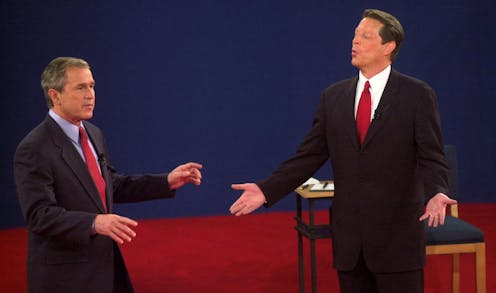
This course explores the history of contested presidential elections
Text saying: Uncommon Courses, from The Conversation
Uncommon Courses[1] is an occasional series from The Conversation U.S. highlighting unconventional approaches to teaching. Title of course: Contested U.S. Presidential Elections What prompted the idea for the course? I was looking for a way to make history relevant to students. Since I research and teach a lot about U.S. politics, I decided to focus on presidential elections that had contested results. Contested elections have happened when candidates failed to win a majority of electoral votes, meaning the House of Representatives had to decide the election; when electoral votes themselves were contested; when problems with vote counts necessitated courts intervening in an election; or when states or candidates refused to accept the results. Coming out of 2020, I saw a lot of anxiety among students – and in society in general – about gearing up for the 2024 election. Offering historical context seemed like a good way to enrich students’ current civic engagement. What does the course explore? We are studying the most-contested U.S. presidential elections: 1800, 1824, 1860, 1876, 2000 and 2020. Candidates failed to win a majority of electoral votes in 1800 and 1824. Sectional rancor over slavery caused states to reject the results in 1860. Disputed electoral votes in 1876 led to a political compromise that resolved the electoral votes in favor of Rutherford B. Hayes in exchange for ending Reconstruction. Problems with vote counting in Florida in 2000 led the Supreme Court to essentially decide the election in Bush v. Gore. And most recently in 2020, then-President Donald Trump disputed the results unsuccessfully. We are covering a wide swath of U.S. political history[2] in just eight weeks. Students are also writing a blog for public audiences and submitting other public writing, like op-ed pieces, to stretch their own historical thinking and communication skills and help the public contextualize the present election. Why is this course relevant now? People are asking whether U.S. democracy can survive the 2024 election. Students are learning how the system has been shaped by previous crises in legitimacy. One example is when the electoral tie between Thomas Jefferson and Aaron Burr in 1800 led to the ratification of the 12th Amendment that established separate electoral votes for the president and vice president. The worst crisis came when Southern states rejected Abraham Lincoln’s election in 1860 and decided to secede from the United States, leading to the Civil War. What’s a critical lesson from the course? History can’t predict the future, but it can provide key context to understand the present. The U.S. electoral system has weaknesses, such as the Electoral College, built in by the Constitution, but the acceptance of the results by losers has been a key to U.S. political stability through many different contested elections over time. Before 2020, no presidential candidate had ever contested the final election results. For instance, Andrew Jackson won both the popular vote and a plurality of the Electoral College vote in 1824, but Jackson accepted John Quincy Adams as the legitimate president when the House of Representatives decided the winner. Jackson, however, accused Speaker of the House Henry Clay of a “corrupt bargain”[3] to hand Adams the presidency in return for appointing Clay as secretary of state. Jackson still recognized Adams as the legitimate president but beat him badly in the next election in 1828. What materials does the course feature? The students have analyzed scholarly articles and many primary sources, mostly collected by the Library of Congress. Several important books have also shaped their thinking: Jim Downs’ 2024 “January 6 and the Politics of History[4]”; E. J. Dionne and William Kristol’s 2001 “Bush v. Gore: The Court Cases and the Commentary[5]”; and Kate Cote Gillin’s 2014 “Shrill Hurrahs: Women, Gender, and Racial Violence in South Carolina, 1865-1900[6].” What will the course prepare students to do? Students in the class are using historical skills and ways of thinking to help themselves, their friends and anyone else to put the current election into perspective. They are all doing final projects that use what they’ve learned in class to communicate with the public through op-eds, social media projects, websites and other creative projects in the lead-up to the 2024 election. They are prepared for their own civic engagement and with skills in journalism and public communication.

Authors: Sarah J. Purcell, Professor of History, Grinnell College

Read more https://theconversation.com/this-course-explores-the-history-of-contested-presidential-elections-240420

Magazine

Compressed Air Pipe and Fittings: What Every Australian Industrial Facility Needs to Know

Compressed air is the fourth utility of modern industry, right alongside electricity, gas, and water. Yet despite its critical role in powering everything from pneumatic tools to automated productio...

Common Risks Hidden in Commercial Lease Agreements

Commercial leases are often longer and more complex than tenants expect, and the fine print can carry significant financial and operational consequences over the years that follow. Many business own...

Corporate Secretarial Services in Singapore: Annual Compliance, Key Filings, and Common Mistake

Annual compliance in Singapore should not be treated as a once-a-year administrative event. It is an ongoing governance system that depends on accurate records, timely filings, disciplined approvals...

hacklink hack forum hacklink film izle hacklink z-libraryhousecleaningchantilly-va.lovable.appesim senegalbetparkbetparktelegram下载zlibrary bookscasino en ligneWPS下载IND RUMMYnon gamstop casinosnon gamstop casinos uknon gamstop casinoscasinos not on gamstopcasinos not on gamstopnon gamstop casinoonline gamblinguk casinosuk casinosStreamEastStreamEastjojobetmeritkingjojobet