Voters shrug off scandals, paying a price in lost trust
- Written by Brandon Rottinghaus, Professor of Political Science, University of Houston
Donald Trump joked[1] in 2016 that he could “stand in the middle of Fifth Avenue and shoot somebody” and not lose support. In 2024, after two impeachments[2] and 34 felony convictions[3], he has more or less proved the point. He not only returned to the White House, he turned his mug shot into décor, hanging it outside the Oval Office[4] like a trophy.
He’s not alone. Many politicians are ensnared in scandal, but they seldom pay the same kind of cost their forebears might have 20 or 30 years ago. My research[5], which draws on 50 years of verified political scandals at the state and national levels, national surveys and an expert poll[6], reaches a clear and somewhat unsettling conclusion.
In today’s polarized America, scandals hurt less, fade faster and rarely end political careers.
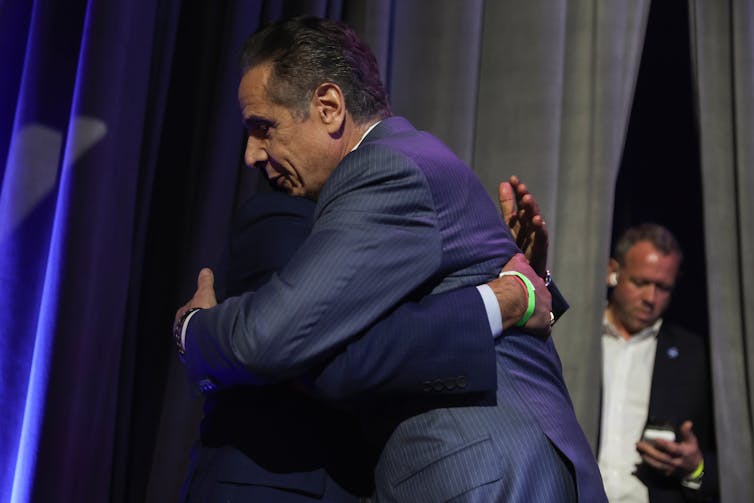
New York’s Andrew Cuomo[7] and New Jersey’s Jim McGreevey[8] both resigned as governors due to sex scandals, only to run again this year for mayoral posts. Both lost. Cuomo sought to replace New York Mayor Eric Adams, who never stepped down despite being indicted – with charges later dropped – in a corruption case[9] that engulfed much of his administration.
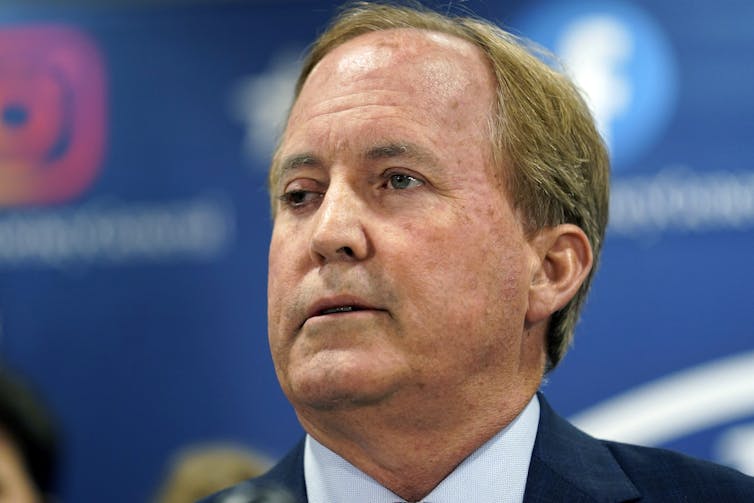
The adulterous state attorney general from Texas, Ken Paxton[10], survived an impeachment vote in 2023 over bribery and abuse of office and is now running for the U.S. Senate. The list goes on – proof that scandal rarely ends a political career.
When scandals still mattered
For most of the previous half-century, scandals had real bite.
Watergate, which involved an administration spying on its political enemies, knocked out President Richard M. Nixon. The Keating Five[11] banking scandal of the 1980s reshaped the Senate, damaging the careers of most of the prominent senators who intervened with regulators to help a campaign contributor later convicted of fraud.
Members of Congress referred to the House ethics committee were far less likely to keep their seats. Governors, speakers and cabinet officials ensnared in scandal routinely resigned. The nation understood scandal as a serious breach of public trust, not a potential fundraising opportunity.
But beginning in the late 1990s and accelerating throughout the Trump era, something changed.
According to my dataset of more than 800 scandals [12] involving presidents, governors and members of Congress, politicians in recent decades have survived scandals for longer periods of time and ultimately faced fewer consequences.
Even at the presidential level – where personal legacy should, in theory, be most sensitive – scandals barely leave a dent. Trump and his supporters have worn his legal attacks as a badge of honor, taking them as proof that an insidious swamp has conspired against him.
This isn’t just a quirk of modern politics. As a political scientist, I believe it’s a threat to democratic accountability. Accountability holds politicians, and the political system, to legal, moral and ethical standards. Without these checks, the people lose their power.
To salvage the basic idea that wrongdoing still matters, the nation will need to figure out how to Make Scandals Great Again – not in the partisan sense but in the civic one.
As a start, both parties could commit to basic red lines – bribery, abuse of office, exploitation – where resignation is expected, not optional. This would send a signal to voters about when to take charges seriously. That matters because, while voters can forgive mistakes, they shouldn’t excuse corruption.
A tribal cue, not an ethical event
Why the new imperviousness?
Partisanship[14] is the main culprit. Today’s voters don’t evaluate scandal as citizens; they evaluate it as fans. Democrats and Republicans seek to punish misdeeds by the other side[15] but rationalize them for their own.
This selective morality is the engine of “affective polarization[16],” a political science term describing the intense dislike of the opposing party that now defines American politics. A scandal becomes less an ethical event than a tribal cue. If it hurts my enemy, I’m outraged. If it hurts my ally, it’s probably exaggerated, unfair or just fake.
The nation’s siloed and shrinking media environment accelerates this trend. News consumers drift toward outlets that favor their politics, giving them a partial view of possible wrongdoing. Local journalism, formerly the institution most responsible for uncovering wrongdoing, has been gutted[17]. A typical House scandal once generated 70 or more stories in a district’s largest newspaper. Today, it averages around 23[18].
Evaluating surveys of presidency scholars, I found that economic growth, time in office, war leadership and perceived intellectual ability all meaningfully shape presidential greatness. Scandals, by comparison, barely move the needle.
Warren G. Harding still gets dinged for Teapot Dome[19], a major corruption scandal a century ago, and Nixon remains defined by Watergate[20]. But for most modern presidents, scandal is just one more piece of noise in an already overwhelming media environment.
At the same time, partisan media ecosystems reinforce voters’ instincts. For many voters, negative coverage of a fellow partisan is not a warning sign. As with Trump, it can be a badge of honor, proof that the so-called establishment fears their champion.
The incentive structure flips. Instead of shrinking from scandal and behavior that could once have ended careers, politicians learn to exploit it. As Texas governor a decade ago, Rick Perry printed his felony mug shot[21] on a T-shirt for supporters. Trump’s best fundraising days[22] corresponded directly to his criminal court appearances.
Making scandals resonate
Even when the evidence is clear-cut, the public’s memory isn’t.
Voters forget scandals that should matter but vividly remember ones that fit their partisan worldview, sometimes even when memory contradicts fact. Years after Trump left office, more Republicans[23] believed his false claims – about the 2020 election, cures for COVID-19 and the Jan. 6 Capitol riot – than during his presidency. The longer the scandal drags on, the foggier the details become, making it easier for partisans to reshape the narrative.
The problem isn’t that America has too many scandals. It’s that the consequences no longer match the misdeeds.
But the story isn’t hopeless. Scandals still matter under certain conditions – particularly when they involve clear abuses of power or financial corruption and, crucially, when voters actually learn credible details. And political scientists have long known that scandals can produce real benefit. They expose wrongdoing, prompt reforms, sharpen voter attention and remind citizens that institutions need scrutiny.
So, what would it take to Make Scandals Great Again, not as spectacle but as accountability?
One step would be to rebuild the watchdogs. Local journalism could use investment, including through nonprofit models and philanthropy.
Second, it’s important that ethics enforcement maintains independence from the political actors it polices. Letting lawmakers investigate themselves guarantees selective outrage. At the same time, however, political parties could play a role in restoring trust by calling out their own, increasing their own accountability by lamenting real offenses among their own members.
Political scandals will never disappear from American life. But for them to serve as silver linings – and, ultimately, to protect public trust – the conditions that give them meaning require restoration. That could foster a political culture where wrongdoing still carries a price and where truth can pierce through the noise long enough for the public to hear it.
References
- ^ joked (www.npr.org)
- ^ two impeachments (www.pbs.org)
- ^ 34 felony convictions (www.npr.org)
- ^ outside the Oval Office (abcnews.go.com)
- ^ My research (cup.columbia.edu)
- ^ expert poll (presidentialgreatnessproject.com)
- ^ Andrew Cuomo (www.politico.com)
- ^ Jim McGreevey (www.nytimes.com)
- ^ corruption case (www.nytimes.com)
- ^ Ken Paxton (www.texastribune.org)
- ^ Keating Five (time.com)
- ^ According to my dataset of more than 800 scandals (doi.org)
- ^ Heather Kalifa/AP (newsroom.ap.org)
- ^ Partisanship (link.springer.com)
- ^ seek to punish misdeeds by the other side (theconversation.com)
- ^ affective polarization (pmc.ncbi.nlm.nih.gov)
- ^ gutted (www.usnewsdeserts.com)
- ^ around 23 (doi.org)
- ^ Teapot Dome (www.history.com)
- ^ Watergate (www.nixonfoundation.org)
- ^ felony mug shot (www.governing.com)
- ^ best fundraising days (www.nytimes.com)
- ^ more Republicans (news.osu.edu)
- ^ Eric Gay/AP (newsroom.ap.org)
Authors: Brandon Rottinghaus, Professor of Political Science, University of Houston
Read more https://theconversation.com/voters-shrug-off-scandals-paying-a-price-in-lost-trust-271077