Hezbollah − degraded, weakened but not yet disarmed − destabilizes Lebanon once again
- Written by Mireille Rebeiz, Chair of Middle East Studies, Dickinson College
The fragile peace in Lebanon was already showing serious strains in the first months of 2026 – and then came the U.S.-Israeli strikes in Iran.
After the killing of Iran’s supreme leader, Ayatollah Ali Khamenei[1], Hezbollah[2] – a Shiite paramilitary group and Iranian proxy operating from Lebanon – retaliated by launching rockets into the north of Israel. Israel responded with fresh strikes on Hezbollah targets in south Lebanon, Beirut and the Bekaa Valley in the east[3].
Hezbollah is not the force in Lebanon it once was[4]. Yet as an expert in Hezbollah affairs[5], I believe the group still maintains the potential to drag Lebanon into conflict and chaos.
Hezbollah is in no position to play an effective role as an ally to Iran in its war with the U.S. and Israel. But the threat of its actions destabilizing Lebanon is real – as is the fear of Israel[6] and Syria[7] using the pretext of Hezbollah’s response now to launch ground invasions and occupy parts of Lebanon.
A failed ceasefire
Hezbollah’s decision to support Iran is in line with the core tenets of the group.
Inspired by the 1979 Iranian Revolution, Hezbollah came into existence in 1985[8] with the publication of a manifesto[9] that detailed its aims for the region. It pledged allegiance to the supreme leader of the Iranian Revolution, Ruhollah Musavi Khomeini, and vowed to fight the Israeli occupation of Lebanon and the Palestinian territories.
Having dominated internal politics and dictated foreign policy for the best part of 40 years, it has been seriously degraded since October 2023, with Israeli strikes taking out much of its leadership. Many in Lebanon hoped that the grip Hezbollah held[10] would soon be a thing of the past.
On Nov. 27, 2024, Israel and Hezbollah agreed to a ceasefire[11] following almost a year of Hezbollah attacks, in solidarity with Hamas, and heavy Israeli shelling in response.
As part of the plan, Hezbollah would withdraw north of the Litani River and Israeli troops would withdraw from southern Lebanon within a 60-day period.
Brokered by the U.S., the agreement was never fully implemented[12]. In fact, Israel kept bombing Lebanon almost on a daily basis while claiming that the Lebanese army is not working fast enough to disarm Hezbollah.
The laying down of Hezbollah’s arms was another term in the ceasefire plan but has been difficult to implement. The Lebanese army recently announced entering an “advanced stage[13]” of the disarmament plan and is currently focused on expanding its presence in the south of Lebanon. But Israel expressed dissatisfaction with the pace of disarmament and claimed that Hezbollah is rearming faster than it was being disarmed[14].
Meanwhile, Hezbollah’s secretary general, Naim Qassem, has repeatedly said that the group will not agree to a full disarmament and withdrawal north of the Litani River while Israel continues striking Lebanon[15].
In fact, since November 2024, Israel Defense Forces targeted Lebanon with 855 strikes[16]. February 2026 alone was marked by 44 strikes[17] – and this was before the current war began.
Earlier this year, speaking in a televised address, Qassem declared that the group would not remain neutral[18] if Israel goes to war against Iran. True to his word, Hezbollah started shelling Israel right after the killing of Khamenei.
But that move has been heavily criticized by other voices in Lebanon[19] who accuse the group of putting Iran’s interests ahead of Lebanon’s and, in effect, killing off a peace process that was already under massive strain.
Dragging a nation into conflict
This is not the first time that Hezbollah has dragged Lebanon into an armed conflict, nor the first time it has rejected the state’s call to disarm.
In July 2006[20], demanding the release of Lebanese prisoners in Israel, Hezbollah fighters entered Israeli territory, kidnapping two Israeli soldiers and killing three. This led to a 34-day war, the loss of 1,000 civilian lives, the weakening of Lebanon’s economy and significant damages to its infrastructure[21].
Then, after the Oct. 7, 2023, attacks[22] by Hamas – and despite the Lebanese state’s numerous calls to remain neutral – Hezbollah vowed solidarity with the Palestinian militants and joined its fight against Israel. What followed was months of tit-for-tat attacks with Israel that escalated into a full-blown war in September 2024[23].
The Lebanese government has been keen to distance itself from Hezbollah’s actions in the current conflict.
In response to Hezbollah’s shelling of northern Israel, the Lebanese cabinet on March 2 outlawed Hezbollah’s military activities[24].
This is a first for Lebanon. Almost half a century ago, Lebanon implicitly legalized Hezbollah and agreed to share security responsabilities[25] – which is almost always exclusively within the hands of the state – with Hezbollah, a nominally nonstate entity.
What impact the ban will have, if any, remains to be seen. It certainly did not seem to make an immediate difference, as Hezbollah continued with its military activities in support of Iran.
Sectarian violence
While intended as a step toward isolating Hezbollah and building a stronger state of Lebanon, the recent ban on Hezbollah’s military activities risks exacerbating Lebanon’s sectarian divide.
It comes at a time when Lebanon and the wider region is going through serious challenges that have left Shiite communities outside Iran feeling vulnerable.
The rise of sectarian violence against Alawites[26] – an offshoot of Shiite Islam – in neighboring Syria is a source of concern to many.
And in Lebanon, the Shiites, who make up a third of Lebanon’s population, suffered the most from both Israel’s 40-year occupation of the south and the 2024 war[27].
As ayatollah, Khamenei was seen as one of the leading spiritual leaders of all Shiites, not just in Iran. His killing and the fact that most Shiites in Lebanon live in the areas[28] that have been heavily targeted by Israel in recent days – south Lebanon, southern Beirut and the Bekaa Valley – will further lead into the narrative that they are a community under threat.
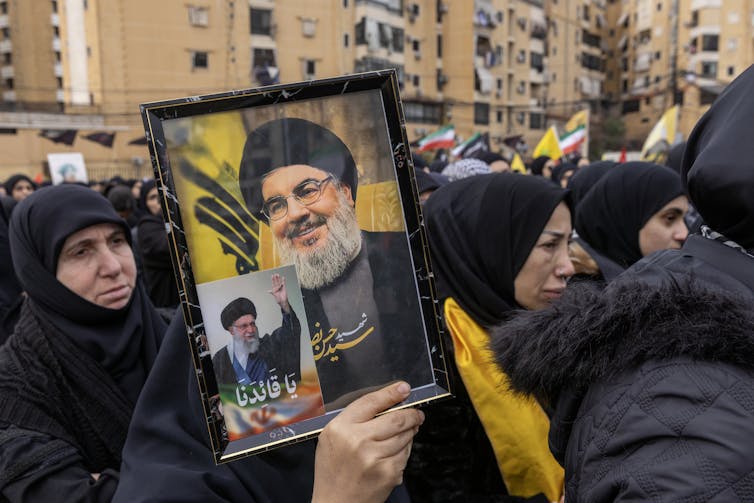
My concern is that tasked with disarming the group, the Lebanese army could be drawn into confrontation with Hezbollah fighters.
Lebanon has a history of such clashes. A serious sectarian confrontation occurred in May 2008[30] when the Lebanese government attempted to dismantle Hezbollah’s private telecommunications network and remove key security officials from Beirut airport.
Hezbollah responded with a swift and violent takeover of West Beirut, which is predominantly Sunni Muslim. Fighters clashed and killed about 110 civilians.
Lebanon was then on the brink, but the Lebanese army’s decision not to get involved in street battles[31] prevented a turn toward civil war.
Ground invasions
But sectarian violence has long dogged Lebanon – and anything that risks the country’s fracturing is to the detriment of all Lebanese people, not just the Shiites. The country is already suffering from a severe economic crisis[32] and only recently came out of a prolonged period of political paralysis, during which Hezbollah blocked successive attempts to install a president[33].
Having made steps toward putting in place a functioning government after the 2024 ceasefire, the other fear, alongside civil strife, is invasion from the north and the south.
The Syrian military[34] has significantly reinforced its presence along the northern border with Lebanon. Thousands of Syrian troops were deployed to supposedly secure the border and prevent the infiltration of Hezbollah militants in Syria. However, many Lebanese fear that Syria may want to invade and occupy parts of Lebanon, like it did during the Lebanese civil war[35].
As for Israel, it is already bombing Lebanon. And Israeli military spokesman Brig. Gen. Effie Defrin said in a public address that it is keeping “all options on the table[36],” including a potential ground invasion of Lebanon.
It follows growing interest in Israel of an expansionist policy toward lands around the current state. In February, Israeli extremists illegally entered south Lebanon and called for its occupation[37]. This also occurred back in December 2024[38]. And in a recent interview, Mike Huckabee, the U.S. ambassador to Israel, seemed to express support for Israel’s expansionist agenda, suggesting that “it would be fine” for Israel to take chunks of Middle East “land[39].”
Hezbollah’s violent death throes?
The U.S.-Israeli strikes on Iran have again shone a light on how much of Lebanon’s future is premised on regional shifts and developments that exacerbate internal divides.
Hezbollah has for the past 40 years been a focus of this dynamic. For months, observers have – for good reason – suggested the Iran-backed group was on its last leg[40]. Instead, it looks like the group might again bring Lebanon to its knees.
References
- ^ Ayatollah Ali Khamenei (www.nbcnews.com)
- ^ Hezbollah (theconversation.com)
- ^ south Lebanon, Beirut and the Bekaa Valley in the east (www.theguardian.com)
- ^ not the force in Lebanon it once was (theconversation.com)
- ^ expert in Hezbollah affairs (theconversation.com)
- ^ Israel (www.nytimes.com)
- ^ Syria (www.reuters.com)
- ^ came into existence in 1985 (theconversation.com)
- ^ publication of a manifesto (www.ict.org.il)
- ^ grip Hezbollah held (theconversation.com)
- ^ Israel and Hezbollah agreed to a ceasefire (www.reuters.com)
- ^ the agreement was never fully implemented (www.amnesty.org)
- ^ advanced stage (www.crisisgroup.org)
- ^ rearming faster than it was being disarmed (www.arabnews.com)
- ^ while Israel continues striking Lebanon (www.reuters.com)
- ^ targeted Lebanon with 855 strikes (israel-alma.org)
- ^ was marked by 44 strikes (israel-alma.org)
- ^ the group would not remain neutral (www.middleeastmonitor.com)
- ^ other voices in Lebanon (www.washingtonpost.com)
- ^ July 2006 (www.britannica.com)
- ^ weakening of Lebanon’s economy and significant damages to its infrastructure (www.hrw.org)
- ^ Oct. 7, 2023, attacks (www.britannica.com)
- ^ full-blown war in September 2024 (theconversation.com)
- ^ outlawed Hezbollah’s military activities (www.aljazeera.com)
- ^ legalized Hezbollah and agreed to share security responsabilities (edinburghuniversitypress.com)
- ^ sectarian violence against Alawites (www.hrw.org)
- ^ and the 2024 war (www.ap.org)
- ^ most Shiites in Lebanon live in the areas (www.refworld.org)
- ^ Daniel Carde/Getty Images (www.gettyimages.co.uk)
- ^ occurred in May 2008 (www.britannica.com)
- ^ Lebanese army’s decision not to get involved in street battles (www.aljazeera.com)
- ^ severe economic crisis (www.worldbank.org)
- ^ Hezbollah blocked successive attempts to install a president (arabcenterdc.org)
- ^ Syrian military (www.reuters.com)
- ^ during the Lebanese civil war (arabcenterdc.org)
- ^ all options on the table (apnews.com)
- ^ entered south Lebanon and called for its occupation (www.newarab.com)
- ^ December 2024 (www.reuters.com)
- ^ take chunks of Middle East “land (www.nbcnews.com)
- ^ Iran-backed group was on its last leg (theconversation.com)
Authors: Mireille Rebeiz, Chair of Middle East Studies, Dickinson College