Why Pete Hegseth’s Pentagon prayer services challenge traditional notions of separation of church and state – but might be blessed by the Roberts Supreme Court
- Written by John E. Jones III, President, Dickinson College
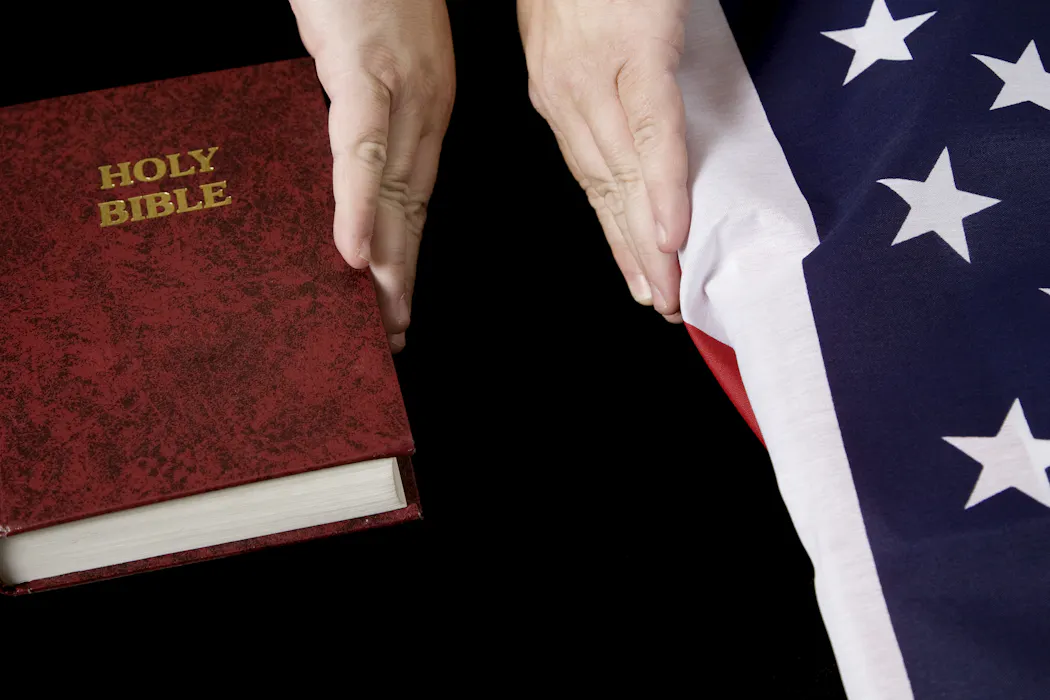
Secretary of Defense Pete Hegseth is engaging in “a proselytizing Christian campaign[1]” in his job, according to The Washington Post.
Hegseth hosts prayer services at the Pentagon and virtually crusades as a Christian, praying at the Pentagon for U.S. troops to inflict “overwhelming violence of action[2] against those who deserve no mercy in Iran.” Politics editor Naomi Schalit spoke with Dickinson College President John E. Jones III about the legal implications of Hegseth’s actions.
Jones was a longtime federal judge, and his most famous decision[3], Kitzmiller v. Dover, was a case in which a district school board ordered the teaching of so-called intelligent design – claimed by advocates to be an alternative to the theory of evolution[4]. Jones’ 139-page decision concluded that it was “abundantly clear” that the board’s policy violated the establishment clause of the Constitution, which forbids the government from creating an official religion or favoring one religion over another.
Schalit: What issues do Hegseth’s behavior and statements raise for you, if any?
Jones: From afar, it looks as if he is flirting with a violation of the establishment clause as contained within the First Amendment[5]. The establishment clause mandates that there can’t be a national religion, nor can the government favor one religion over another.
What appears to be happening at the Pentagon are services that basically recognize only a particular religious tradition. And it’s very notable that Americans United for Separation of Church and State filed suit against both the Defense Department and the Labor Department[6] because there are similar activities that are taking place there.
Defense Secretary Pete Hegseth asked God to “let every round find its mark against the enemies of righteousness and our great nation” during a monthly Christian service at the Pentagon on March 25, 2026.What they’re seeking under the Freedom of Information Act are certain records, because they likely can’t attend these sessions. Any information they receive could support a separate lawsuit that, in effect, says the government – via the departments of Labor and Defense – is violating the establishment clause.
From my perspective, it sure looks like they are in violation. These activities are hosted on government property. They’re potentially coercive and appear to promote one particular religious viewpoint above others. While they may say they’re not requiring people to attend, you don’t know whether there may be some incentivizing or negative consequence if somebody doesn’t come.
Let me be the casual bystander and say, “Gosh, it’s just really nice. He’s a God-fearing man, and you know, he’s saying things that show his belief, which is a good thing to have.” Why did the authors of the Bill of Rights have a problem with the government establishing a state religion?
They were people of their time. They knew England had the Church of England and thus a national religion that was intertwined with the state[7]. It ultimately caused untoward problems. They wanted everyone to have the freedom to worship, or not, as a personal choice[8] and felt very passionately about that.
What has been long debated is the concept of a wall of separation[9] between church and state. That phrase is not in the Constitution, but it is something that appears in cases, or is at least implied. And I’ve often said that wall is somewhat porous because there are circumstances where courts have allowed a little bit of seepage of religion[10] under certain circumstances into the so-called public square.
What is really interesting is the tilt of the current Supreme Court court towards relaxing what have been generations of jurisprudence holding that the establishment clause should be more strictly enforced.
The Kennedy v. Bremerton School District[11] case of 2022 involved a high school football coach assembling his players for prayer after games. It was pretty remarkable in the fact that the Supreme Court ultimately decided that that was not a violation of the establishment clause[12].
Some of the reasons were that it was after the game and that it was not a required activity for the players. Those who opposed it claimed that it was a violation of the establishment clause and that it was inherently coercive.
These current activities by the government – assuming that Americans United for Separation of Church and State files a lawsuit, not just an information request – are very likely to get to the Supreme Court.
The other thing the Supreme Court has done is it abandoned the so-called Lemon test[13], which courts utilized to determine whether a law or practice violated the establishment clause. Particularly in Kitzmiller v. Dover[14], I found the Lemon test to be a really helpful vehicle to use in measuring whether the policy in that case, which involved a school board mandating the teaching of the so-called alternative to evolution – intelligent design – violated the establishment clause.
President John F. Kennedy says people unhappy with a 1962 Supreme Court decision banning prayers in public schools can “pray a good deal more at home.”How did the Lemon test work?
The Lemon test says that a judge should first measure the purpose of the government’s action, and then the effect on a reasonable person. You can then go to a third point, which is whether it represents an excessive entanglement with religion.
It doesn’t fit every case, but it worked in most establishment clause challenges.
But the Supreme Court, first in Kennedy v. Bremerton School District[15], pronounced it dead[16].
They in effect said to judges, “You have to look at historical antecedents and traditions and so forth.” That’s great writing at the Supreme Court level, but it leaves district judges completely unmoored. So whomever the poor judge is who gets this case is likely going to have a difficult time trying to read the tea leaves to determine whether it is, in fact, a violation[17]. And I guarantee you, there won’t be unanimity among jurists and lawyers on that point.
So you’ve got a case where in the old days there was legal scripture that said, “OK, apply these tests and you can tell whether the government has stepped over the line into endorsing religion.” But now the Supreme Court has made it unclear where that line is?
Yes, and the very fact that Americans United for Separation of Church and State is trying to get information under the Freedom of Information Act means that they know that you have to come armed with a lot of salient surrounding facts in order to have this declared unconstitutional.
If this had been 10 or 20 years ago, they probably wouldn’t have filed that action under the Freedom of Information Act. They would have directly challenged the law and in effect said, “Look, it speaks for itself. You have services favoring one religion over others within the Pentagon and Labor departments. It’s inherently unconstitutional and a violation of the establishment clause.”
But we’re in a post-Lemon world today where there is a relaxation of the previously recognized constraints[18] of the establishment clause.
Where does that get the country?
I fear where it goes if the progression continues. The proponents of this kind of behavior ask, “What’s wrong with a little of that good old-time religion in the public square?”
They never appear to contemplate the fact that in generations hence, America could, for example, be a predominately Muslim population. Suppose that became the favored religion in a country, or any religion that may be embraced by some but be disfavored by others became the favored religion. The establishment clause is meant to protect everyone, including, by the way, nonbelievers and atheists.
There’s nothing in the establishment clause that says that you can’t worship – or not – as you see fit. And that’s the beauty of this country. The founders knew that if there was a move towards a favored or national religion in the eyes of the government, that could replicate what took place in Great Britain, where religion and politics mixed with occasionally terrible results.
Failure to adhere to the dictates of the church could render you a second-class citizen, or worse. My hope is that judges will be very, very careful about a systemic creep that totally eviscerates the purpose and intent of the establishment clause.
References
- ^ a proselytizing Christian campaign (www.washingtonpost.com)
- ^ overwhelming violence of action (www.theguardian.com)
- ^ his most famous decision (www.documentcloud.org)
- ^ intelligent design – claimed by advocates to be an alternative to the theory of evolution (www.nytimes.com)
- ^ establishment clause as contained within the First Amendment (www.uscourts.gov)
- ^ filed suit against both the Defense Department and the Labor Department (www.military.com)
- ^ a national religion that was intertwined with the state (www.law.cornell.edu)
- ^ the freedom to worship, or not, as a personal choice (www.americanbar.org)
- ^ a wall of separation (firstamendment.mtsu.edu)
- ^ a little bit of seepage of religion (www.congress.gov)
- ^ Kennedy v. Bremerton School District (www.law.cornell.edu)
- ^ that was not a violation of the establishment clause (theconversation.com)
- ^ Lemon test (firstamendment.mtsu.edu)
- ^ Kitzmiller v. Dover (law.justia.com)
- ^ first in Kennedy v. Bremerton School District (verdict.justia.com)
- ^ pronounced it dead (journals.law.harvard.edu)
- ^ whether it is, in fact, a violation (www.congress.gov)
- ^ relaxation of the previously recognized constraints (verdict.justia.com)
Authors: John E. Jones III, President, Dickinson College