UAE’s OPEC exit has been long in the works – and may mark the beginning of a Gulf realignment
- Written by Kristian Coates Ulrichsen, Fellow for the Middle East at the Baker Institute, Rice University
The United Arab Emirates’ decision to withdraw[1] from the Organization of Petroleum Exporting Countries will leave the oil cartel weakened at a crucial time. It also illustrates the ongoing tensions between the UAE and Saudi Arabia, OPEC’s largest producer and de facto leader.
The UAE announced on April 28, 2026, that it will depart OPEC and OPEC+, an expanded grouping which includes Russia, on May 1, depriving the groups of their third- and fourth-largest[2] oil producer, respectively.
Though the move may seem abrupt, as a close observer of the UAE and intra-Gulf politics[3], I believe Abu Dhabi’s decision to leave OPEC and go it alone was in the cards for a while and follows years of Abu Dhabi’s complaints about the cartel.
The announcement also follows years of divergence[4] between Emirati and Saudi oil policies, as well as the growth of competitive rivalries[5] between the two countries over wider regional questions. This rift between the two largest Sunni Gulf states burst into the open[6] in December 2025, when competing visions for security in Yemen threatened to reignite civil conflict in the war-torn country.
Unity in the face of Iranian attacks[7] since then should not mask that underlying split, of which the UAE’s OPEC decision is merely the latest manifestation.
The world’s most prominent cartel
OPEC formed in 1960 as a way for the main oil producers to set production limits and therefore control the price of crude around the world.
The UAE has been a member of OPEC[8] since the seven-emirate federation was established in 1971, although Abu Dhabi – the emirate that holds 95% of Emirati oil reserves – has been a member since 1967.
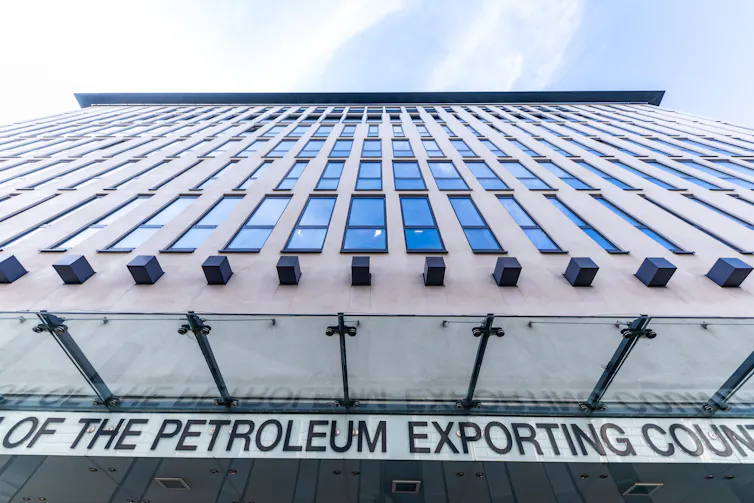
At its height in the mid- and late-1970s, OPEC played a powerful role in reshaping the balance of power between oil producers and consumers, and countering Western dominance in a postcolonial setting of resource nationalization.
While other members have withdrawn from OPEC in recent years – such as Qatar in 2019[10] and Angola in 2024[11] – the impact of the UAE’s departure is on a far greater scale, affecting about 12% of OPEC’s total oil output.
Furthermore, the exit of the UAE removes one of the few major swing producers from OPEC, weakening the organization’s ability to respond rapidly to changing market conditions in the future.
Diverging Gulf priorities
The UAE has been signaling a potential split for at least five years, when differences of opinion with Saudi Arabia on how to manage oil policy emerged ahead of a November 2020 OPEC+ summit. The rift became openly visible[12] during a subsequent meeting of OPEC+ countries in July 2021.
In both cases, the UAE wished to increase oil production – which had been sharply curtailed by OPEC members during the COVID-19 pandemic – while the Saudis sought to maintain high prices by keeping output lower and prices higher.
In part, this reflects the different circumstances of the two Gulf nations. The Saudis are reliant on higher oil prices to drive the revenues needed to fund its lavish budget and pay for massive infrastructure projects like its Vision 2030 project[13]. The Emirati economy, on the other hand, is more diversified and less directly dependent on oil revenues.
Instead, Abu Dhabi has invested heavily in recent years to expand capacity[14] to be able to increase oil production from 3.4 million barrels a day before the U.S.-Israel war against Iran to 5 million barrels a day by 2027 – and potentially higher later on. This reflects a desire to monetize its reserves and move the oil to market to avoid the risk of stranded assets should global demand fall in any future transition away from fossil fuels.
Shorn of the constraints of OPEC quotas[15], which the Emiratis have chafed against for years, officials in Abu Dhabi will be able to increase production should it wish to do so once the impasse with Iran is broken and the Strait of Hormuz fully reopens.
Post-Iran war regional shifts
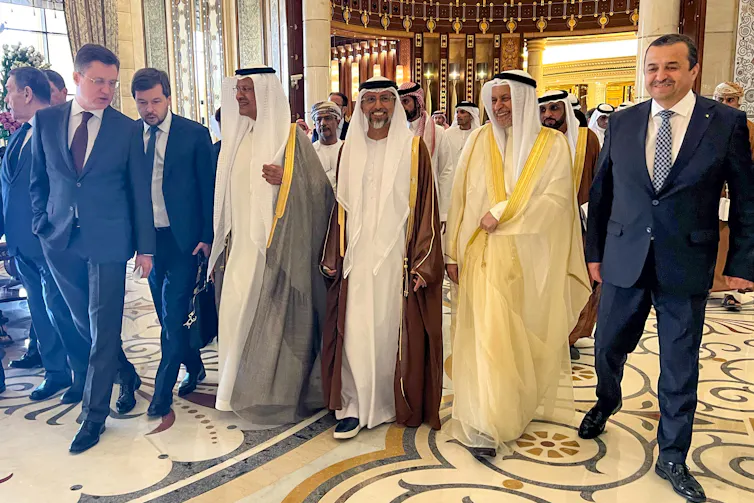
It is clear that UAE leadership is first and foremost intent on doubling down on the pursuit of its national interests, with an emphasis on prioritizing ties with the U.S. – and likely also Israel – over those with countries that Abu Dhabi feels reflect an old world it is now seeking to leave behind.
While the war in Iran may have temporarily overshadowed the eruption of Saudi-Emirati tensions over Yemen and visions for the region, the rift had not been resolved prior to the U.S. and Israeli launch of military operations on Feb. 28.
Comments by prominent Emiratis have suggested that officials in the UAE have paid close attention to which countries have, in their view, stepped up to assist the UAE in times of crisis, and which have not.
The OPEC decision thus reflects a calculation in Abu Dhabi that there is no longer any utility in remaining part of a Saudi-dominated organization. The UAE’s reconsideration of other memberships[17], such as the Arab League, Organization of Islamic Conference or even the Gulf Cooperation Council, may be next, as the UAE and other regional countries begin to think ahead to an uncertain post-war landscape.
References
- ^ decision to withdraw (www.wsj.com)
- ^ third- and fourth-largest (www.ft.com)
- ^ close observer of the UAE and intra-Gulf politics (www.bakerinstitute.org)
- ^ years of divergence (www.forbes.com)
- ^ competitive rivalries (ecfr.eu)
- ^ burst into the open (theconversation.com)
- ^ Iranian attacks (theconversation.com)
- ^ member of OPEC (www.bakerinstitute.org)
- ^ Christian Bruna/Getty Images (www.gettyimages.com)
- ^ Qatar in 2019 (www.brookings.edu)
- ^ Angola in 2024 (www.bbc.com)
- ^ openly visible (www.aljazeera.com)
- ^ Vision 2030 project (www.vision2030.gov.sa)
- ^ expand capacity (www.eia.gov)
- ^ constraints of OPEC quotas (www.nytimes.com)
- ^ Haitham El-Tabei/AFP via Getty Images (www.gettyimages.com)
- ^ of other memberships (agsi.org)
Authors: Kristian Coates Ulrichsen, Fellow for the Middle East at the Baker Institute, Rice University