John Adams and Thomas Jefferson disagreed about the American Revolution’s meaning even as they lay dying
- Written by Marianne Holdzkom, Professor of History, Kennesaw State University
Like Americans today, the people living in the United States in 1826 were preparing to celebrate a milestone for their country. July Fourth of that year marked the 50th anniversary of the Declaration of Independence[1].
As what was known as the “Jubilee” of American independence approached, Americans realized that the founding generation was dying off. They wanted to take advantage of the founders’ insight while they still could.
This meant soliciting memories and advice from the signers of the Declaration, only three of whom were still alive. Thomas Jefferson and John Adams were the men most closely associated with the independence movement, yet they both lay dying and both declined invitations[2] to attend the festivities planned for July Fourth[3].
But they were able to answer letters from younger men interested in their perspective on the revolution and subsequent history they had helped shape.
As an Adams scholar and someone interested in how he is remembered[4], I have studied with interest his response to the questions posed to him. He also wrote a good deal about the revolution to his friend and onetime rival, Jefferson.
These two men – who had worked well together during the American Revolution – could not have been more different[5]. Both had thought long and hard about what the American Revolution meant to them. They did not always agree.
If Americans today are looking for a unified vision of their country in their own 250th celebrations, they will not find it with Adams or Jefferson.

Rival friends
After the Revolutionary War, Adams and Jefferson became political rivals. They disagreed about how powerful the federal government should be and on foreign policy at a time when England and France, once again at war, were presenting challenges to the new country.[7].
Jefferson founded the Democratic-Republican Party to counter the influence of Alexander Hamilton’s Federalist Party. While Adams never formally aligned with the Federalists, he agreed with many of their policies, especially on foreign policy.
As a result, the friendship between Adams and Jefferson unraveled. For years, they did not speak or correspond until a mutual friend, Benjamin Rush, encouraged their reconcilation[8].
On New Year’s Day, 1812, Adams was the first to reach out. He used the excuse of sending to Jefferson a pamphlet written by his son[9], John Quincy, saying that it was from “One who was honoured in his youth with Some of your Attention and much of your kindness.” Adams continued, in casual language, to tell Jefferson about the family and wished him a happy new year.
Jefferson responded warmly, telling Adams, “A letter from you calls up recollections very dear to my mind[10].”
From that time on, the two wrote to each other on a regular basis, discussing every topic imaginable, from agriculture to religion. Yet it was clear that their past rift was on Adams’s mind when he wrote, “You and I, ought not to die, before We have explained ourselves to each other[11].”
In the process, they revisited the days when they worked together to form a new nation. As they reflected on the meaning of the United States’ birth, they agreed that writing a history of the American Revolution was next to impossible.
Adams wrote to Jefferson: “Who shall write the history of the American revolution? Who can write it? Who will ever be able to write it[12]?”
The problem, as Adams saw it, was that so much was done in secret. Nobody recorded the debates and speeches of the Continental Congress, the governing body during the revolution. Therefore, how could a true history ever exist?
Jefferson agreed. After restating Adams’ question about who could write a true history, Jefferson’s response was “nobody; except merely it’s external facts[13].”
On this, they could agree. On some of the specifics, they did not.
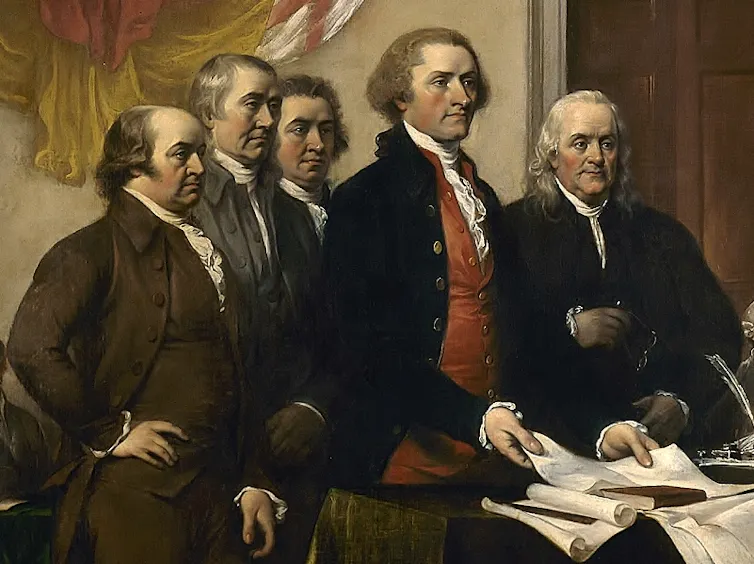
Fundamental difference
In old age, Adams remembered vividly how he convinced Jefferson to write the Declaration of Independence[15]. One historian has argued that Adams’ memory seems a bit too clear, and suggested that he was working to elevate himself in the process of telling the story by claiming that he alone persuaded a reluctant Jefferson to take on the task.
However, scholars still accept Adams’ version[16] of this event. Jefferson remembered the incident differently[17], stating that he was urged by the entire committee charged with producing the declaration, not just Adams, to take on the task and that he was happy to comply.
More important than the details was the ultimate interpretation by these two men of what they had accomplished 50 years before.
What their letters written after the Jubilee committee’s invitation reveal is a fundamental difference in their attitudes about the human spirit. Adams wrote that he appreciated the invitation and was sorry to decline. He called the birth of the U.S. “a Memorable epoch in the annals of the human race[18].”
Yet he also demonstrated his realistic view of human beings when he wrote that the independence movement would “form the brightest or the blackest page, according to the use or abuse of those political institutions by which they shall be shaped by the human mind.”
Adams understood that people interpret history according to their own circumstances. He was a realist who could not bring himself to accept the fundamentally optimistic view that humanity was always moving toward liberty[19].
Jefferson, on the other hand, was hopeful about the revolution’s impact on the world. He believed that the declaration would be “the Signal of arousing men to burst their chains.” The entire letter[20] to the Jubilee committee offered an optimistic view of the future in which the human race was always progressing toward freedom.
When Adams and Jefferson died on July 4, 1826, their lives took on new meaning. In eulogizing them, House member Daniel Webster told the American public: “They are no more. They are dead. But how little is there of the great and good which can die! To their country they yet live, and live forever[21].”
Now, 200 years later, Americans still look to these Founding Fathers for inspiration. However, what Adams and Jefferson demonstrate is not unity. Instead, they exemplify the capacity for people to disagree and yet work for a common cause.
References
- ^ 50th anniversary of the Declaration of Independence (archivesfoundation.org)
- ^ both declined invitations (blogs.loc.gov)
- ^ attend the festivities planned for July Fourth (www.loc.gov)
- ^ Adams scholar and someone interested in how he is remembered (mcfarlandbooks.com)
- ^ could not have been more different (www.pbs.org)
- ^ Library of Congress Printed Ephemera Collection (www.loc.gov)
- ^ were presenting challenges to the new country. (history.state.gov)
- ^ mutual friend, Benjamin Rush, encouraged their reconcilation (wallbuilders.com)
- ^ sending to Jefferson a pamphlet written by his son (founders.archives.gov)
- ^ A letter from you calls up recollections very dear to my mind (founders.archives.gov)
- ^ explained ourselves to each other (founders.archives.gov)
- ^ Who will ever be able to write it (founders.archives.gov)
- ^ nobody; except merely it’s external facts (founders.archives.gov)
- ^ Detail from John Trumbull's 1818 painting in the U.S. Capitol, via Wikipedia (upload.wikimedia.org)
- ^ convinced Jefferson to write the Declaration of Independence (cooperative-individualism.org)
- ^ scholars still accept Adams’ version (constitutioncenter.org)
- ^ Jefferson remembered the incident differently (founders.archives.gov)
- ^ a Memorable epoch in the annals of the human race (founders.archives.gov)
- ^ humanity was always moving toward liberty (lawliberty.org)
- ^ entire letter (founders.archives.gov)
- ^ they yet live, and live forever (landmarkevents.org)
Authors: Marianne Holdzkom, Professor of History, Kennesaw State University