More women, same inequalities: How symbolic violence quietly persists in Indonesian diplomacy
- Written by Kanti Pertiwi, Assistant Professor in Organisation Studies, Universitas Indonesia
Although the world of diplomacy often seen as glamorous and progressive, women and men continue to operate within a gender order that privileges masculine norms[1], while women still struggle[2] to be recognised fully as diplomats and as independent subjects, beyond their social roles as wives or mothers.
Our recently published policy brief[3] reveals a side of diplomacy that is rarely discussed, and is even considered taboo: how symbolic violence[4] — a form of domination in everyday life by the dominant group through written and unwritten rules — is reproduced through formal and informal institutional practices.
We focus particularly on the everyday experiences of women in diplomacy — both female diplomats and the wives of diplomats.
Everyday diplomacy in postcolonial Indonesia
In Indonesia, diplomats are also civil servants, making them subject to a range of written and unwritten bureaucratic rules, including the legacy of “state ibuism[5]” — a state-sponsored gender ideology formulated during Suharto’s New Order era.
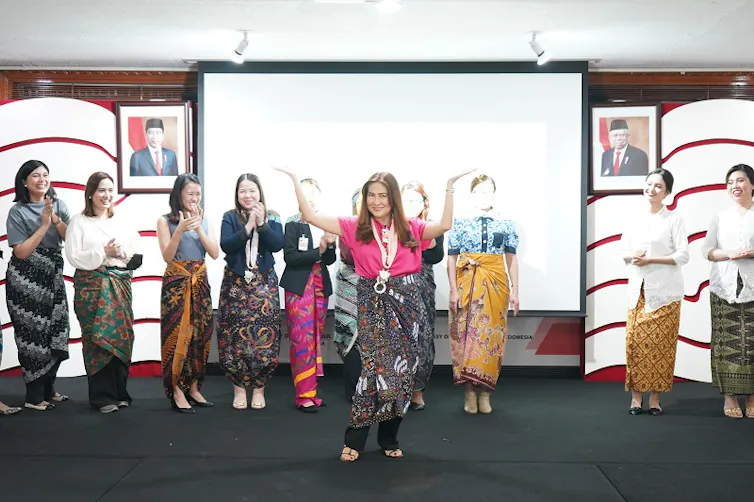
Our research is the first to integrate an analysis of everyday diplomatic practices with a historical understanding of how state ibuism operates in and around diplomatic institutions.
In everyday diplomacy, both female diplomats and diplomats’ wives are expected to embody the ibu (mothers) ideal — that women should be fully responsible in taking care of their children, skilful in hospitality, catering, decoration, and femininely dressed.
In various ways, the women diplomats in our study narrated how they are often assigned to handling catering duties, shopping for office needs, and attending arisan, a rotating savings gathering.
These are akin to symbolic violence[7] maintained through rules and social punishments. They normalise and reproduce gender hierarchy through everyday organisational routines, often sustained by those who, having internalised these norms, become complicit in reproducing them and consider them as neutral.
The wives of diplomats are also expected to be loyal partners who support their husband’s mission abroad without pay. This often means mastering traditional cooking, performing traditional dances, and playing traditional musical instruments such as gamelan and angklung.
Such practices are consistent with the research finding that 42% of our study participants[8], consisting of diplomats and their spouses, reported experiencing unpleasant treatment because of their gender.
Indonesian embassies and consulates around the world often treat diplomats’ wives as cultural agents, a practice rooted in the New Order institutional legacy of Dharma Wanita[9] (women’s virtue), a social organisation composed of the wives of civil servants.
Despite claims of reforms, it continuously promotes state ibuism[10].
One of our participants elaborated on how those who are not willing to participate fully in Dharma Wanita often face intimidation and social sanctions.
These seemingly mundane practices quietly reinforce a patriarchal gender order and constitute forms of symbolic violence, creating distressing experiences for many of our participants, both diplomats and their spouses.
Debunking myths
Many assume that having more women in diplomacy automatically signals a more equitable diplomatic field[11]. This perception is misleading.
Symbolic violence continues to operate quietly through everyday norms and expectations, reproducing gendered hierarchies despite numerical gains.
As a result, broader representation does not necessarily translate into equal access to social capital, visibility, or strategic opportunities. Women may enter in greater numbers, yet still find themselves constrained by gendered expectations that determine the roles they can take on and how their contributions are valued.
Another myth worth debunking is the belief that empowered, educated women from privileged backgrounds are somehow immune to violence. This is simply untrue.
First, examining how gender functions within elite institutions reveals how power operates at the top tiers of society. Women holding “elite” state positions show how the state shapes and enforces a narrative of the “ideal woman.”
Second, privilege does not erase gendered power. Even privileged women[12] continue to experience structural inequalities – often in more subtle ways. Privilege can mask, rather than eliminate, systems of gender domination.
Why gendered practices endure in MoFA
Our research shows despite the growing number of women entering the diplomatic corps, especially within the Ministry of Foreign Affairs (MoFA), everyday gendered practices continue to persist.
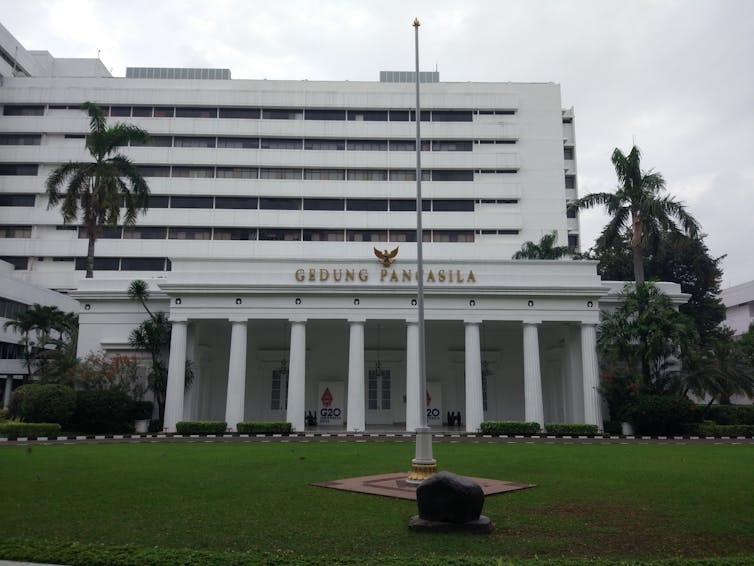
This persistence is deeply shaped by MoFA’s militaristic organisational style[14] inherited from the New Order era. Following the 1965–66 purge, Suharto embedded military logic into MoFA’s structure and culture through the hybridisation[15] of Cold War anti-communist ideology with US military family norms.
This influence continued even after the Reform era. MoFA retained key New Order legacies,[16] such as rigid hierarchy, a culture of seniority, and moral conservatism regarding gender roles. These cultural residues form the institutional terrain in which State Ibuism continues to take hold.
As a result, the logic of housewifisation[17] persists: women diplomats and diplomats’ wives are expected to embody ibu-like morality, supporting representational roles such as event hosting and cultural performances, and adhere to gendered norms of behaviour and appearance.
The military-style gender regime of the New Order thus continues to shape diplomatic femininity and constrain women’s authority in Indonesia’s foreign service.
Possibilities for disruption
To move forward, MoFA must begin by recognising the limitations of its existing organisational culture. Our policy brief offers three recommendations:
First, the current gender mainstreaming strategy should continue, but it needs to move beyond performative metrics. A rigorous audit is essential to assess its real impact on women and on others whose voices are rarely heard within the bureaucracy.
Second, strong leadership commitment is essential to chart a meaningful path forward and strengthen the institution. Leaders serve as key gatekeepers, determining how far gender mainstreaming can move beyond symbolic compliance.
Finally, MoFA needs a permanent gender task force capable of sustained coordination, monitoring, and cultural change. Such a task force should provide consistent leadership and oversight, ensuring that gender mainstreaming achieves continuity and quality rather than remaining a collection of isolated activities.
References
- ^ masculine norms (www.cambridge.org)
- ^ struggle (journals.sagepub.com)
- ^ policy brief (www.researchgate.net)
- ^ symbolic violence (journals.sagepub.com)
- ^ state ibuism (perpustakaan.komnasham.go.id)
- ^ KBRI Manila. (www.niaga.asia)
- ^ symbolic violence (www.tandfonline.com)
- ^ 42% of our study participants (www.researchgate.net)
- ^ Dharma Wanita (setjen.mpr.go.id)
- ^ state ibuism (www.thejakartapost.com)
- ^ that having more women in diplomacy automatically signals a more equitable diplomatic field (www.idntimes.com)
- ^ privileged women (www.sciencedirect.com)
- ^ Influez Studio/Shutterstock (www.shutterstock.com)
- ^ MoFA’s militaristic organisational style (www.jstor.org)
- ^ hybridisation (www.degruyterbrill.com)
- ^ MoFA retained key New Order legacies, (www.jstor.org)
- ^ housewifisation (libcom.org)
Authors: Kanti Pertiwi, Assistant Professor in Organisation Studies, Universitas Indonesia