Trump’s framing of Nigeria insurgency as a war on Christians risks undermining interfaith peacebuilding
- Written by Aili Mari Tripp, Vilas Research Professor of Political Science, University of Wisconsin-Madison
Nigeria “must do more to protect Christians,” a senior U.S. State Department official demanded on Jan. 22, 2026, during a high-level security meeting[1] in the African nation’s capital, Abuja.
The comment followed an attack just days earlier in which more than 160 worshipers were kidnapped from three churches[2] in Nigeria’s northern Kaduna state.
The security meeting came a month after the United States, in cooperation with the Nigerian government, launched an airstrike[3] from a U.S. Navy ship in the Gulf of Guinea on the northwest Sokoto state. During the Christmas Day incident, 16 Tomahawk missiles costing around US$32 million[4] hit several locations the U.S. claimed were being used by extremist groups.
There were no verifiable casualties, although the strike did send a signal that the U.S. administration is willing to take military action when it is deemed necessary. President Donald Trump heralded the attack a “Christmas present” to Christians[5] and later warned that there would be more strikes if the killings of Christians continued.
As a scholar of African politics[6], I know that calling the insurgency in Nigeria a persecution of Christians – as the U.S. administration has repeatedly done – is simplistic and ill-informed. Yes, Christians have been killed and kidnapped as part of the prolonged terrorism campaign by Boko Haram and other extremist groups. But so too have other groups in the country, including Muslims. Moreover, the religious identity of the victims masks other motives of the militant groups involved.
I recently carried out interviews in Maiduguri, Borno State – the epicenter of Boko Haram activities in northeast Nigeria – as part of research into interfaith efforts[7] to counter threats from Islamic extremists. For many of those interviewed, the insurgency and violence have often served to unite Nigerians with different religious identities against a common enemy: the groups making their life a misery. The danger of Trump’s narrative of this being a war on Christians is that it could undermine such efforts to build cross-community trust.
A complex conflict
Since 2009 there have been 54,000 deaths related to the violence in Nigeria and the surrounding Lake Chad region, according to independent violence monitor ACLED[8].
The Christmas airstrike by the U.S. was in northwest Nigeria, targeting a small group of Lakurawa militants. But 85% of all incidents related to Islamic fighters in 2025 were in northeast Nigeria, according to ACLED.
Northern Nigeria is primarily populated by Muslims, in contrast to the whole of the country, whose 240 million people are split roughly[9] 56%-43% between Muslims and Christians[10].
Many of those killed and abducted in the insurgency in the north have been Christian. But the exclusive focus on Christians by the U.S. administration overlooks the complex realities behind the violence in Nigeria, which incorporates not just extremist groups but also farmer-herder tensions, land and water disputes exacerbated by climate change, ethnic rivalries, poverty and organized criminal gangs referred to as “bandits[11].”
Boko Haram, which regards the Nigerian state[12] as its main target, has killed both Christians and Muslims, as has the Ansaru[13], an al-Qaida affiliate. The Islamic State – West Africa Province[14], another major insurgency group, targets state forces and Christians.
While the most recent high-profile attacks have been on churches, Boko Haram also targets markets, mosques and homes. They are opportunistic attacks that don’t discriminate between Muslims and Christians.
To be sure, the Nigerian government’s response to the insurgency has been inadequate[15]. But again, the reasons are complex and the result of a confluence of factors, including corruption in the security sector, negligence and the difficulty of targeting groups that employ guerrilla tactics outside of government control, which make them especially elusive. Political factors may also be at play, since elements within the Nigerian government may be complicit with northern politicians backing some of the land-grabbing and kidnapping bandits.
Even with these barriers, some progress has been made. According to the Africa Center for Strategic Studies[16], Boko Haram attacks have declined by 50% since 2014-2016, when they were most active, although rates have been increasing again since 2023.
Interfaith efforts
The Nigerian government itself has welcomed assistance from the U.S. targeting insurgents, but with the proviso that Nigeria’s sovereignty and territorial integrity be respected[17].
The concern is that military action on the part of the U.S. under the guise of protecting Christians in Nigeria could make matters worse. It risks exacerbating tensions within the country and giving credence to those in Nigeria and abroad who focus only on the killing of Christians for their own narrow purposes.
At the same time, it could undermine the efforts of civil society organizations and women’s associations, in particular, that have worked hard to build interfaith trust between Muslims and Christians to tackle the insurgency threat.
Some of these organizations, such as the Women of Faith Peacebuilding Network[18], have been at the forefront of the fight against militant groups. An interfaith movement founded in 2011, it now comprises over 10,000 Christian and Muslim women. It carries out vocational training and promotes interfaith dialogue and strategies to reduce conflict.
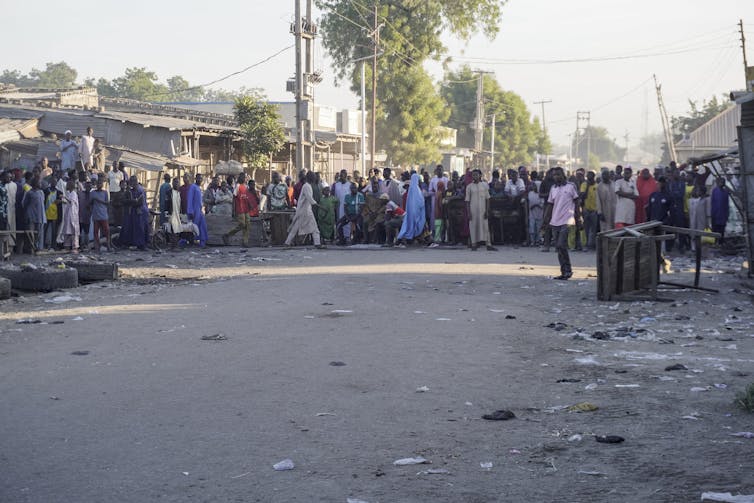
Following the abduction of over 300 schoolgirls by Boko Haram in Chibok[20], Borno State, in 2014, a coalition of women’s rights organizations – comprising both Christian and Muslim members – mobilized to protest the kidnappings.
The Federation of Muslim Women’s Associations in Nigeria[21], or FOMWAN, is another organization that is actively engaged in interfaith initiatives nationwide. In a January 2024 interview, a FOMWAN member based in Maiduguri told me that the Boko Haram crisis has united women across religious divides more than ever before.
Maryam, whose name I have changed along with other interviewees to protect their identity, explained: “FOMWAN has been in existence for many years before the insurgency. And in our activities we had been teaching our Muslim women religious tolerance in Borno. But the insurgency has made us put more efforts into making sure there is religious tolerance among Muslims and Christians.”
A Christian evangelist preacher, Mary, told me that working together had significantly reduced the mutual fear and mistrust between Muslims and Christians. Before the rise of Boko Haram, interfaith collaboration between the two groups was low. But today, she noted, it is far higher.
“We came to understand that this set of people doing this killing are neither Christian nor Muslim. They’re working for selfish interests, not for religious interests. We now strategize and come together to work as one. The key issue to (the conflict) is poverty. The only solution is for us is to speak with one voice. That’s the only way for us to survive.”
‘Each other’s keeper’
The U.S. administration would, I believe, do well to listen to the voices of these Christian and Muslim peacebuilders in northern Nigeria who live with the daily threat of violence.
Their lived experience has informed an approach to Nigeria’s insurgency based on shared purpose that cuts across religious divides.
In the words of activist Mama Pro, when asked why she was so keen to build interfaith bridges in Northern Nigeria: “We are always each other’s keeper.”
References
- ^ high-level security meeting (www.vanguardngr.com)
- ^ kidnapped from three churches (www.bbc.com)
- ^ launched an airstrike (www.ft.com)
- ^ 16 Tomahawk missiles costing around US$32 million (www.washingtonpost.com)
- ^ Christmas present” to Christians (www.politico.com)
- ^ scholar of African politics (ailitripp.com)
- ^ research into interfaith efforts (doi.org)
- ^ according to independent violence monitor ACLED (acleddata.com)
- ^ 240 million people are split roughly (www.worldometers.info)
- ^ 56%-43% between Muslims and Christians (www.pewresearch.org)
- ^ criminal gangs referred to as “bandits (africacenter.org)
- ^ regards the Nigerian state (www.dni.gov)
- ^ Ansaru (www.dni.gov)
- ^ Islamic State – West Africa Province (www.dni.gov)
- ^ has been inadequate (theconversation.com)
- ^ Africa Center for Strategic Studies (africacenter.org)
- ^ Nigeria’s sovereignty and territorial integrity be respected (www.reuters.com)
- ^ Women of Faith Peacebuilding Network (connect2dialogue.org)
- ^ Audu Marte/AFP via Getty Images (www.gettyimages.com)
- ^ 300 schoolgirls by Boko Haram in Chibok (www.ohchr.org)
- ^ Federation of Muslim Women’s Associations in Nigeria (www.fomwanofficial.org)
Authors: Aili Mari Tripp, Vilas Research Professor of Political Science, University of Wisconsin-Madison