When a president is unfit for office, here’s what the Constitution says can happen
- Written by Kirsten Matoy Carlson, Professor of Law and Adjunct Professor of Political Science, Wayne State University
Bipartisan calls[1] for President Donald Trump’s removal from office[2] increased on April 7, 2026, after he issued threats to destroy “a whole civilization[3]” if Iran[4] refuses to reopen the Strait of Hormuz.
These calls have come from across the political spectrum, from Democratic Reps. Alexandria Ocasio-Cortez of New York and Melanie Stansbury of New Mexico to former Rep. Marjorie Taylor Greene and right-wing pundit Alex Jones[5]. Unlikely allies seem to agree that the president has gone too far and needs to be reined in.
Their concerns have emerged as Iran has walked away from talks[6] to end the war and Trump’s language suggests that he plans to escalate it[7] by destroying the country’s power plants and bridges[8].
Concerns over Trump’s fitness for office[9] have grown in recent weeks[10] as his commentary has become more erratic[11].
If lawmakers do attempt to remove Trump from office, here’s what would happen:
25th Amendment
The Constitution’s 25th Amendment[13] provides a way for high-level officials to remove a president from office. It was ratified in 1967 in the wake of the 1963 assassination[14] of John F. Kennedy – who was succeeded by Lyndon Johnson, who had already had one heart attack – as well as delayed disclosure of health problems experienced by Kennedy’s predecessor, Dwight Eisenhower.
The 25th Amendment provides detailed procedures on what happens if[15] a president resigns, dies in office, has a temporary disability or is no longer fit for office.
It has never been invoked against a president’s will, and has been used only to temporarily transfer power[16], such as when a president is undergoing a medical procedure requiring anesthesia.
Section 4 of the 25th Amendment[17] authorizes high-level officials – either the vice president and a majority of the Cabinet or another body designated by Congress – to remove a president[18] from office without his consent when he is “unable to discharge the powers and duties of his office.” Congress has yet to designate an alternative body, and scholars disagree over the role, if any, of acting Cabinet officials[19].
The high-level officials simply send a written declaration to the president pro tempore of the Senate – the longest-serving senator from the majority party – and the speaker of the House of Representatives, stating that the president is unable to discharge the powers and duties of his office. The vice president immediately assumes the powers and duties of the president.
The president, however, can fight back. He or she can seek to resume their powers by informing congressional leadership in writing that they are fit for office and no disability exists. But the president doesn’t get the presidency back just by saying this.
The high-level officials originally questioning the president’s fitness then have four days to decide whether they disagree with the president. If they notify congressional leadership that they disagree, the vice president retains control and Congress has 48 hours to convene to discuss the issue. Congress has 21 days to debate and vote on whether the president is unfit or unable to resume his powers.
The vice president remains the acting president until Congress votes or the 21-day period lapses. A two-thirds majority vote by members of both houses of Congress is required to remove the president from office. If that vote fails or does not happen within the 21-day period, the president resumes his powers immediately.

The case for impeachment
Article II of the Constitution authorizes Congress to impeach and remove the president – and other federal officials – from office for “Treason, Bribery, or other high Crimes and Misdemeanors[21].” The founders included this provision as a tool to punish a president for misconduct and abuses of power. It’s one of the many ways[22] that Congress could keep the president in check, if it chose to.
Impeachment proceedings begin in the House of Representatives. A member of the House files a resolution for impeachment. The resolution goes to the House Judiciary Committee, which usually holds a hearing to evaluate the resolution. If the House Judiciary Committee thinks impeachment is proper, its members draft and vote on articles of impeachment. Once the House Judiciary Committee approves articles of impeachment, they go to the full House for a vote.
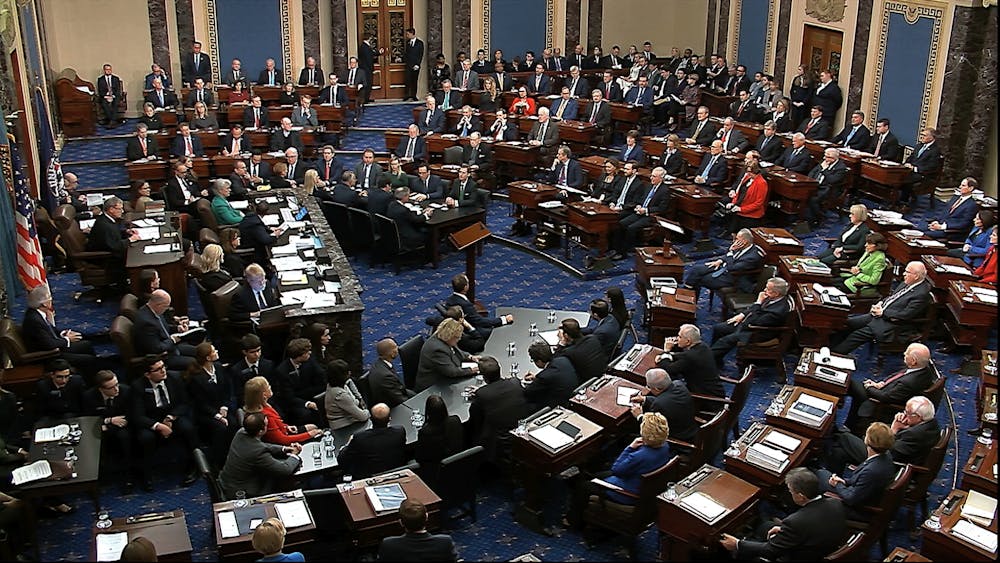
If the House of Representatives impeaches a president or another official, the action then moves to the Senate. Under the Constitution’s Article I[23], the Senate has the responsibility for determining whether to remove the person from office. Normally, the Senate holds a trial, but it controls its procedures[24] and can limit the process if it wants.
Ultimately, the Senate votes on whether to remove the president – which requires a two-thirds majority, or 67 senators. To date, the Senate has never voted to remove a president from office, although it almost did in 1868, when President Andrew Johnson escaped removal from office by one vote[25].
The Senate also has the power to disqualify a public official from holding public office in the future. If the person is convicted and removed from office, only then can senators vote on whether to permanently disqualify that person[26] from ever again holding federal office. Members of Congress proposing the impeachment of Trump have promised to include a provision[27] to do so. A simple majority vote[28] is all that’s required then.
This is an updated version of an article originally published on Jan. 9[29], 2021.
References
- ^ Bipartisan calls (www.forbes.com)
- ^ President Donald Trump’s removal from office (www.axios.com)
- ^ a whole civilization (www.washingtonpost.com)
- ^ Iran (theconversation.com)
- ^ Rep. Marjorie Taylor Greene and right-wing pundit Alex Jones (newrepublic.com)
- ^ Iran has walked away from talks (www.npr.org)
- ^ he plans to escalate it (www.pbs.org)
- ^ destroying the country’s power plants and bridges (www.nbcnews.com)
- ^ Trump’s fitness for office (www.cnn.com)
- ^ in recent weeks (www.npr.org)
- ^ commentary has become more erratic (www.thedailybeast.com)
- ^ Senate Television via AP (newsroom.ap.org)
- ^ 25th Amendment (www.law.cornell.edu)
- ^ ratified in 1967 in the wake of the 1963 assassination (www.history.com)
- ^ what happens if (constitutioncenter.org)
- ^ temporarily transfer power (www.cnbc.com)
- ^ Section 4 of the 25th Amendment (theconversation.com)
- ^ to remove a president (www.law.cornell.edu)
- ^ acting Cabinet officials (www.vox.com)
- ^ National Archives via AP (newsroom.ap.org)
- ^ Treason, Bribery, or other high Crimes and Misdemeanors (www.archives.gov)
- ^ many ways (theconversation.com)
- ^ Article I (www.archives.gov)
- ^ it controls its procedures (theconversation.com)
- ^ President Andrew Johnson escaped removal from office by one vote (www.senate.gov)
- ^ permanently disqualify that person (www.senate.gov)
- ^ promised to include a provision (www.rollcall.com)
- ^ simple majority vote (law.justia.com)
- ^ an article originally published on Jan. 9 (theconversation.com)
Authors: Kirsten Matoy Carlson, Professor of Law and Adjunct Professor of Political Science, Wayne State University