What a Chinese crackdown on corruption meant for Beijing’s high-end restaurant market
- Written by Rui Du, Assistant Professor of Economics, Oklahoma State University
Corruption crackdowns are bad for businesses that thrive on their proximity to political power centers. In fact, they can change the physical layout of an entire industry.
That is what my colleagues and I found when we looked at the impact[1] of a major Chinese government campaign against corruption on Beijing’s restaurants.
In 2012, the Chinese Communist Party introduced its eight-point regulation initiative[2]. This put in place new rules to stop public officials enjoying lavish banquets and luxury travel, or having extravagant meetings at the expense of taxpayers and businesses.
The sudden change in rules in China presented an opportunity for us to explore a hidden and under-researched force: how being close to political power shapes the economy.
We looked at the restaurant industry in Beijing before and after the crackdown to evaluate how political power has an influence on where businesses build and whom they serve.
Using data from Dianping, which is China’s version of Yelp, we looked at hundreds of thousands of customer reviews and spending reports from 2010 to 2014. We also recorded the locations of 120 government offices and observed tens of thousands of nearby restaurants.
Our results showed an immediate drop in business for restaurants near government offices after the new rules were implemented. Customer visits fell by 5.5%, and average spending per person dropped by 2.7%.
This equated to about US$400 million in lost sales each year for restaurants in Beijing. Fancy and expensive dining spots were hit hardest.
This sudden drop didn’t happen just because official funding for these meals was cut. Rather, the strict new accountability measures acted as a powerful deterrent, making it far too risky for politicians and businesses to be seen indulging in lavish spending right next to government offices.
One of the most striking findings was the longer-term impact. By 2016, the entire physical layout of the restaurant industry in Beijing had changed.
Before the crackdown, high-end dining spots were built closely around political power centers. Afterward, the market adapted, and these restaurants spread out into regular shopping districts and residential neighborhoods.
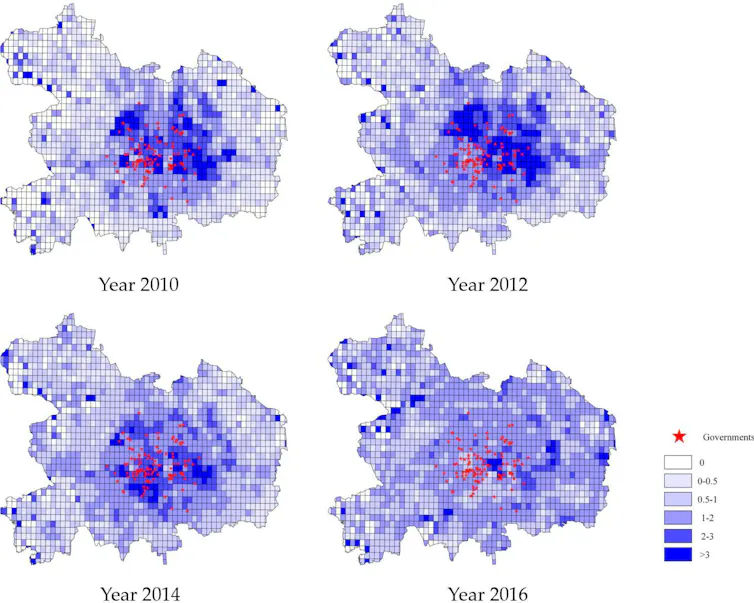
This suggests that the geography of political power directly changes the shape of local economies. It brings wealth and resources together in ways that normal market forces cannot explain.
Why it matters
Economists often study why businesses build close to one another. They usually highlight market forces like population size, customer demand or public transit hubs.
Our research suggests that political power also shapes where businesses decide to plant their flag. Government hubs hold local economies in place: They create networks of private businesses that quietly depend on being near politicians.
It also highlights the hidden costs of political corruption crackdowns – that the economic fallout extends far beyond the intended targets. In the case of our study, the target was corrupt politicians and lavish spending, but the fallout extended to the surrounding restaurant industry.
And the implications of our research extend beyond China. The Trump administration in the U.S. canceled many federal office leases[5] in 2025. Ending federal contracts, moving workers or shutting down agencies could, our study indicates, pull hundreds of millions of dollars out of nearby areas.
The lesson is clear for policymakers, city planners and real estate investors: Cutting budgets or closing government offices might achieve a specific goal; however, these actions cause a ripple effect that can hurt nearby private contractors, retail stores and service providers.
What we don’t know
Our study clearly shows that government reforms and limits on spending can impact local industries. What our research doesn’t show is: Is it worth it?
High-end restaurants in Beijing lost millions of dollars, but the anti-corruption campaign may have reduced broader waste. It might have redirected public money toward more useful, long-term social projects.
Calculating the total costs and benefits of these sudden political shifts remains a complex challenge.
In future research, we hope to explore that question and also how these dynamics play out across different political systems and societies.
The Research Brief[6] is a short take about interesting academic work.
References
- ^ looked at the impact (doi.org)
- ^ eight-point regulation initiative (www.idcpc.org.cn)
- ^ Filipe Campante/Rui Du/Weizeng Sun/Jianghao Wang/Siqi Zheng (www.sciencedirect.com)
- ^ CC BY (creativecommons.org)
- ^ canceled many federal office leases (www.politico.com)
- ^ Research Brief (theconversation.com)
Authors: Rui Du, Assistant Professor of Economics, Oklahoma State University