Is Trump heading to a Pyrrhic victory in Iran?
- Written by Andrew Latham, Professor of Political Science, Macalester College
President Donald Trump has claimed victory[1] in the war in Iran even before the conflict is over. But despite killing the country’s leader[2] and seriously degrading its military[3], there is an argument being made that the Islamic Republic has emerged[4] all the stronger[5] for having simply survived.
Indeed, a phrase that[6] has repeatedly cropped up[7] as the U.S. has sunk more and more military hardware and credibility[8] into Operation Epic Fury is “Pyrrhic victory.”
That term also shows up in Iraq War retrospectives[9], in postmortems of U.S. operations in Libya[10] and in just about every serious attempt to make sense of the past two decades of Western intervention in the Middle East.
But what exactly is a Pyrrhic victory? And is the U.S. really heading toward one in Iran?
1 king, 2 battles and a rueful remark
Most people use the phrase “Pyrrhic victory” to mean a win that costs more than it was worth to obtain it. That’s close enough – but it leaves out a crucial part of the story that makes the concept worth using.
Let’s go back to the beginning[11]. In 280 B.C., Pyrrhus, the king of the ancient Greek kingdom Epirus, crossed into what is now southern Italy to fight Rome. He won major battles at Heraclea and then again at Asculum the following year.
But both victories hurt Pyrrhus. His officer corps was getting chewed up, and his best troops came from a small kingdom far from the fighting. They could not be replaced on anything like Rome’s scale.
After Asculum, he is said to have uttered[12], “If we are victorious in one more battle with the Romans, we shall be utterly ruined.” Plutarch wrote it down for posterity, and the line outlived everything else known about the campaign.
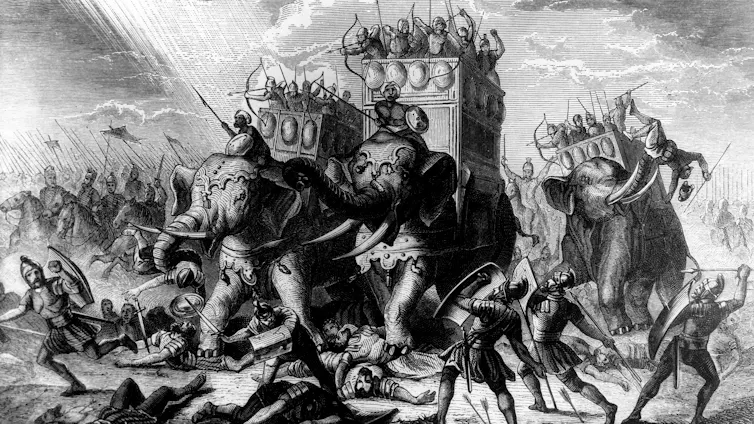
The problem wasn’t that Pyrrhus paid a high price for victory. Rather, it was that every victory shifted the balance against him.
A war can be costly without being “Pyrrhic.” If you come out of a battle clearly stronger than the opponent, then whatever the bill, something real was gained. The Pyrrhic case is when the side that claims victory is, in fact, in a weaker position than when the fighting started.
From Baghdad to Tripoli …
So how does that all relate to U.S. conflicts in the 21st century?
Iraq in 2003 is the obvious starting point. U.S. and coalition forces dismantled Saddam Hussein’s regime[14] in just three weeks. On its own terms, the operation worked. But it also collapsed the Iraqi state[15] in the process: army gone, ministries hollowed out and police absent.
What followed, in broad terms, was insurgency, sectarian war and then the rise of the Islamic State group[16].
Saddam’s Iraq also functioned as one of the main checks on Iranian power in the Persian Gulf. Not by design, and not in any cooperative sense, but as a rival that kept Tehran boxed in. Removing Saddam cleared space for Iran[17] to exert regional influence not enjoyed since 1979.
The current war in Iran[18] does not make sense without that shift. The U.S. went into Iraq to eliminate one purported threat – and ended up amplifying another.
The U.S. intervention in Libya in 2011[19], as part of a NATO force, looked cleaner. The air campaign was short, Libyan leader and longtime thorn in the side of Washington Moammar Gadhafi was dead[20] within eight months – killed by his own countrymen. NATO had set out to protect civilians and remove a regime, and it did both.
The problem was what came next[21]. Libya was Gadhafi’s state, and there was no real plan for a post-Gadhafi Libya. After he fell, what was left was division[22]: militias, competing governments and an arms stockpile that flooded south into the Sahel region of North Africa and fueled conflicts that rage to this day.
Elsewhere, governments drew a blunt conclusion: Complying with demands to dismantle weapons of mass destruction programs, as Gadhafi had done, does not enhance security. In fact, it may have the opposite effect.
Both Libya and Iraq were, in this sense, “Pyrrhic victories” – battlefield triumphs that left the U.S. in a worse overall strategic situation than before.
… and on to Iran?
It is too soon to confidently pass judgment on where the war in Iran sits among these other wars.
But the outlines are visible. Iran’s Supreme Leader Ali Khamenei is gone[23], and the country’s missile forces and naval assets have taken heavy damage.
Washington has declared victory[24], and by its own metrics there is an argument for that.

But on the other side of the ledger, Iran still largely holds the Strait of Hormuz – with leverage it did not exercise before the war.
Meanwhile, oil prices of nearly US$100 a barrel[26] have rippled through the global economy, and Russia, without firing a shot, is positioned to reap the windfall[27].
The issue of Iran’s nuclear program – one of the many stated drivers of the U.S. campaign – now seems less likely to be resolved than before[28]: A state that has absorbed this level of punishment has stronger reasons to want a deterrent, not weaker ones.
Getting the concept right
So, is Trump following the route of Pyrrhus? A Pyrrhic victory is not just a painful one – it is a victory that leaves one worse off against the same opponent. The question that tends to get skipped when the fighting stops is what, exactly, winning changed.
Pyrrhus had his answer after Asculum. Looking at the Strait of Hormuz, the oil markets, the stalled talks in Islamabad, and an Iran with even more reason to pursue a nuclear deterrent, perhaps Trump will soon have his.
This article is part of a series explaining foreign policy terms[29] commonly used but rarely explained.
References
- ^ claimed victory (www.politico.com)
- ^ killing the country’s leader (www.nbcnews.com)
- ^ seriously degrading its military (www.aljazeera.com)
- ^ Islamic Republic has emerged (www.npr.org)
- ^ all the stronger (www.nytimes.com)
- ^ phrase that (www.newstatesman.com)
- ^ cropped up (nationalinterest.org)
- ^ military hardware and credibility (www.firstpost.com)
- ^ Iraq War retrospectives (responsiblestatecraft.org)
- ^ postmortems of U.S. operations in Libya (foreignpolicy.com)
- ^ back to the beginning (www.britannica.com)
- ^ said to have uttered (www.history.com)
- ^ ullstein bild/ullstein bild via Getty Images (www.gettyimages.com)
- ^ dismantled Saddam Hussein’s regime (www.cfr.org)
- ^ collapsed the Iraqi state (www.belfercenter.org)
- ^ rise of the Islamic State group (www.wilsoncenter.org)
- ^ cleared space for Iran (time.com)
- ^ current war in Iran (theconversation.com)
- ^ U.S. intervention in Libya in 2011 (www.justice.gov)
- ^ Moammar Gadhafi was dead (www.hrw.org)
- ^ what came next (thedailyeconomy.org)
- ^ what was left was division (thedailyeconomy.org)
- ^ Supreme Leader Ali Khamenei is gone (www.politico.com)
- ^ has declared victory (apnews.com)
- ^ Majid Saeedi/Getty Images (www.gettyimages.com)
- ^ oil prices of nearly US$100 a barrel (www.cnbc.com)
- ^ positioned to reap the windfall (www.bloomberg.com)
- ^ less likely to be resolved than before (theconversation.com)
- ^ series explaining foreign policy terms (theconversation.com)
Authors: Andrew Latham, Professor of Political Science, Macalester College
Read more https://theconversation.com/is-trump-heading-to-a-pyrrhic-victory-in-iran-280859